carnival games in Hidden Meadows.
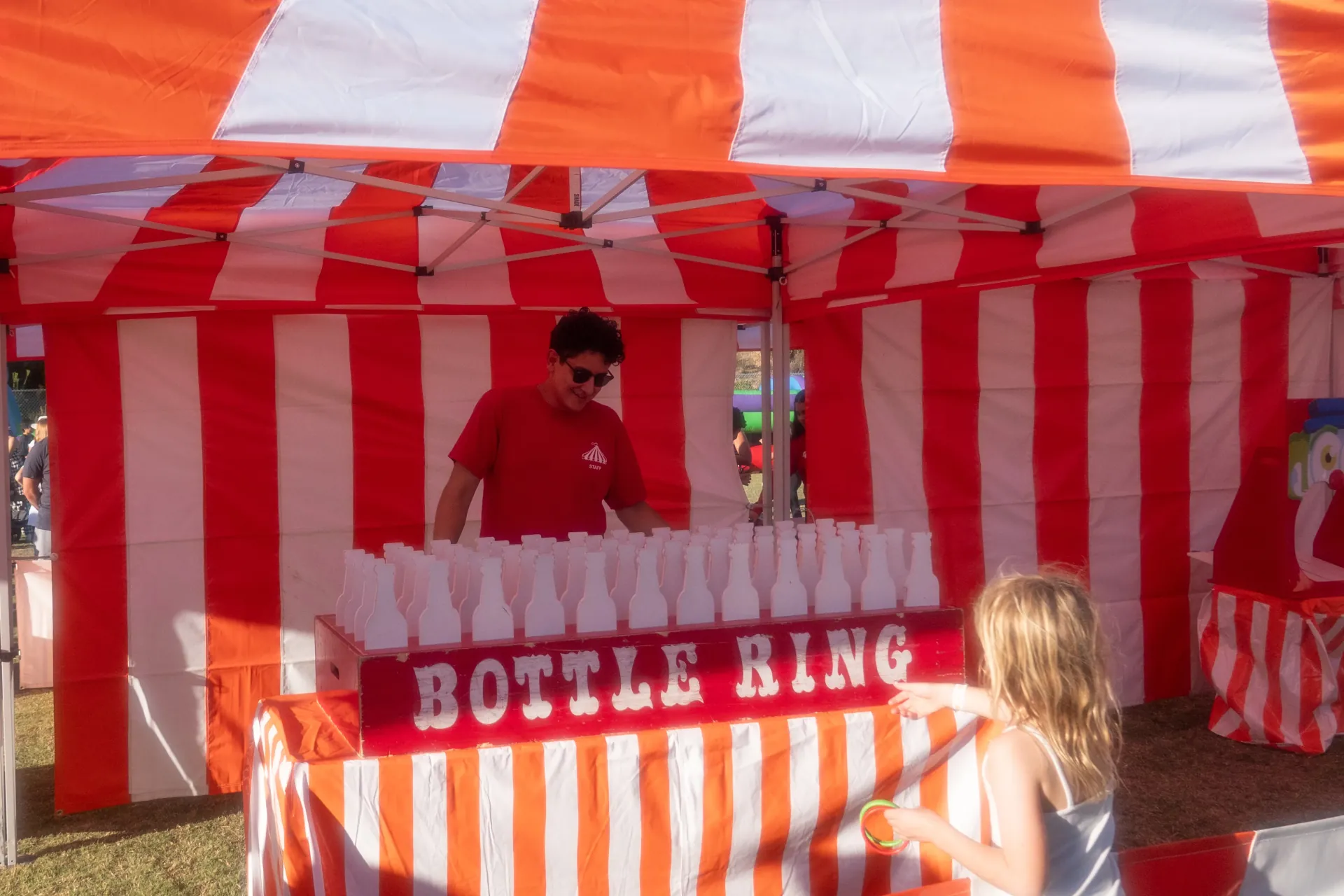
A carnival game is a single freestanding booth — ring toss, bottle ring, plinko, balloon pop, milk-can toss, basketball pop, or fishing for ducks — built around one simple skill or chance mechanic and stocked with prizes so every player walks away with something. As part of a complete event My Little Carnival produces in Hidden Meadows, these booths usually show up in a run of six to twelve, sized to the guest count and lined up together rather than dropped off one at a time. This is a local guide to carnival games in Hidden Meadows — what these booths are, how they get used at school carnivals, fundraisers, and backyard gatherings, and what the logistics look like on the area's larger rural lots.
Hidden Meadows sits in the hill country north of Escondido — a mostly unincorporated community of larger residential lots, winding roads, and open space that borders Daley Ranch. There's no downtown blacktop or big central school campus the way there is in denser cities, so carnival games here tend to land in one of two places: a private backyard or driveway with enough flat pad to line up a few booths, or a community gathering at a spot like Hidden Meadows Park or Walnut Grove Park. Families in the Escondido Union School District and Valley Center-Pauma Unified School District boundary areas also book games for school fall fests and PTA fundraisers held on nearby campuses.
My Little Carnival builds carnival game lineups into full event productions across Hidden Meadows and the wider San Diego County backcountry, sizing the booth count to whatever footprint the property or venue actually has.
How carnival games show up as part of an event in Hidden Meadows.
Because Hidden Meadows properties tend to be larger and more spread out than a typical suburban lot, the games usually line up along a driveway apron, a flat section of yard, or a rented pavilion area rather than a school blacktop. A run of six games might stretch across a wide side yard; a twelve-game fundraiser layout needs the kind of open, level ground that a community park or a school's upper field provides. Each booth is a self-contained unit — striped canvas, a prize rack, and the game mechanism itself — so the crew can stage them in whatever configuration the space allows, whether that's a straight line, an L-shape, or a loose horseshoe around a central walkway.
Inside a full My Little Carnival event build, the games are one piece of a larger layout that might also include an inflatable, a concession station, and a photo backdrop. Guests move between stations at their own pace; an attendant or a parent volunteer restocks prizes and keeps the line moving at each booth. For a backyard birthday, three or four games is typical; for a school carnival or church fundraiser drawing a few hundred people, the count climbs toward eight to twelve so lines don't back up.
What's typically included.
-
Game booth unit.
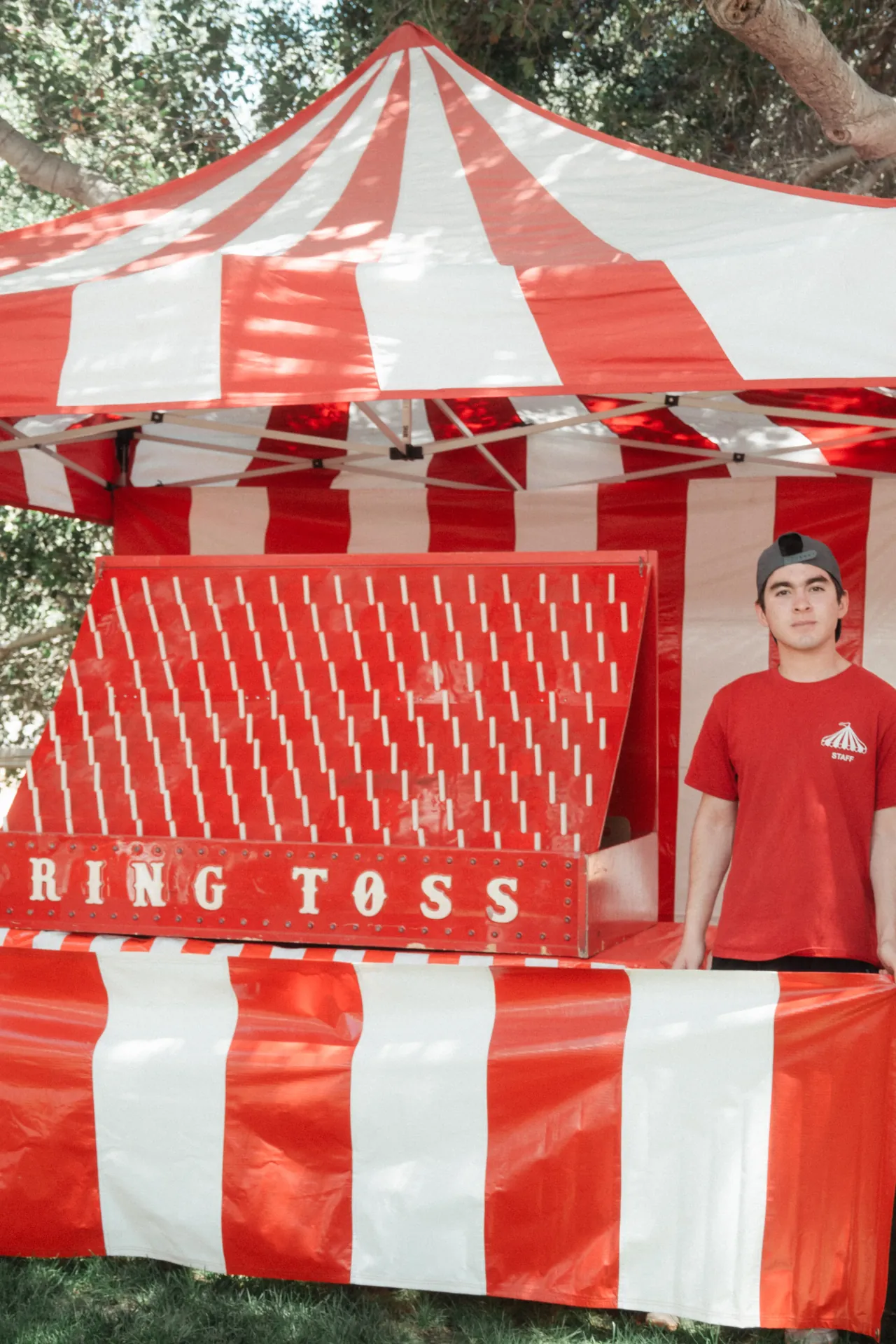
Each game — ring toss, bottle ring, plinko, balloon pop, milk-can toss, basketball pop, duck fishing — arrives as a complete freestanding station with striped skirting and signage.
-
Prize inventory.
Every booth is stocked with consolation and top-tier prizes matched to the event size, so no game runs dry mid-event.
-
Game variety selection.
My Little Carnival mixes skill-based games (ring toss, basketball pop) with pure-chance games (plinko, duck fishing) so younger and older guests both have something to win.
-
Attendants (optional add-on).
Trained staff to run the booths are available per booth or per hour, quoted separately — or the games can be volunteer-staffed, which is common for backyard parties and small fundraisers.
-
Delivery, setup, and breakdown.
Booths are staged, leveled, and prize-loaded before the event starts and struck at the end — no equipment left behind for the host to store or move.
-
Layout planning.
The crew sizes and arranges the booth run to fit the actual footprint — a driveway, a backyard, or a park pavilion area — during the quote conversation.
Typical timeline for carnival games in Hidden Meadows.
- 1
4-8 weeks out
Booth count and game mix get roughed in against guest count and the property's usable flat space. Booking in advance matters more here than in denser cities, since many Hidden Meadows properties need a site check before games get finalized.
- 2
1-2 weeks out
Final guest count, game selection, and staffing decision (attendant add-on versus volunteer-run) are locked in. Any venue paperwork — park permit or school facility-use form — gets submitted.
- 3
Event day setup
Crew arrives ahead of the event window to stage and level each booth, load prizes, and run through the game mechanisms before doors open or guests arrive.
- 4
Event window + breakdown
Games run for the contracted window, staffed by attendants or volunteers, then the crew packs everything out — no equipment or prize stock left on-site afterward.
Specifics for Hidden Meadows.
- Ground and footprint: Hidden Meadows lots are larger than average but often sloped or terraced. A flat driveway apron, a leveled backyard pad, or a park's paved or turf area all work; steep or uneven ground usually needs a walk-through before the booth count is finalized.
- Power needs: Most carnival games run without power. Lighted booths for evening events or a plinko board with an electronic scoreboard are the exceptions — a nearby household outlet usually covers it, and a generator is brought in for park or open-lot events without outdoor power access.
- Venue paperwork: Private backyard and driveway setups need no permit. Events at Hidden Meadows Park or Walnut Grove Park go through the applicable park-use permit process, and school-based fundraisers within Escondido Union School District or Valley Center-Pauma Unified School District boundaries typically require a facility-use form and a Certificate of Insurance.
- Attendant vs. Volunteer staffing: Backyard parties commonly run games with parent or family volunteers; school carnivals and larger fundraisers more often add a trained attendant per booth so lines move and prizes get tracked accurately.
- Open-space neighbors: Properties bordering Daley Ranch and similar open space sometimes have wildlife-aware setup considerations — mainly securing prize inventory and food waste at the end of the night, which the crew handles during breakdown.
- Weather: Southern California's typically dry climate makes outdoor game setups low-risk most of the year. Afternoon sun in the hill country can run hot in summer, so shade positioning for booths is worth flagging when the layout gets planned.

Common questions.
Do the games need a flat, paved surface?
A level surface is what matters more than the material — grass, pavers, concrete, or packed dirt all work as long as it's reasonably flat. Given how many Hidden Meadows properties have sloped yards, it's worth mentioning the terrain when requesting a quote.
Are attendants included with the games?
Not by default. Carnival games are commonly volunteer-run for backyard parties and smaller fundraisers. A trained attendant per booth is available as an add-on and is quoted separately — most useful for larger school carnivals or fundraisers where prize tracking and line management matter more.
Is there an age limit on carnival games?
No hard age limit — most games are designed so a young child and an adult can both play. Skill-based games like basketball pop skew toward older kids and adults; chance-based games like duck fishing work well for the youngest guests.
How many games do we actually need?
For a backyard birthday, three or four games is typical. For a school carnival or community fundraiser expecting a couple hundred guests, six to twelve keeps lines moving. The right count depends on guest flow more than a fixed formula, and gets worked out during the quote.
Do the games need power?
Most don't. A handful of games with lighting or electronic components need a nearby outlet, and a generator is brought along for park or open-lot bookings without accessible power.
What happens if it rains?
Southern California's typically dry climate keeps weather risk low for outdoor game setups. For events planned during a wetter stretch of the year, it's worth discussing a rain-date option or a covered-area alternative when booking.
About this guide.
This local guide to carnival games in Hidden Meadows was compiled by My Little Carnival, the San Diego County division of My Little Carnival — producers of school carnivals, fundraisers, and backyard events across the region.
Helpful local references: Escondido Union School District · Valley Center-Pauma Unified School District
Carnival Games in nearby cities.
Planning carnival games for an event in Hidden Meadows?
Share the date, the venue or property details, and your rough guest count — and My Little Carnival will scope a game lineup and send a quote sized for the space.
Get a quote →