school carnivals in Pacific Beach.
A school carnival is an on-campus fundraising event built around carnival game booths, concession machines, and a play-through-tickets-or-wristbands model that funds a PTA's budget for the year. It runs three to four hours, usually on a Friday evening or Saturday, with equipment delivered same-day, attendants running the booths, and parent volunteers filling in the rest. In Pacific Beach — a coastal San Diego neighborhood with tight, closely packed campuses and a strong PTA fundraising culture — the format is well established even though lot sizes and layouts vary block to block. This is a local guide to school carnivals in Pacific Beach: how they're typically run, where they fit on campus, and what a planning committee should know before locking a date.
Every school in Pacific Beach falls under San Diego Unified School District, and campuses here tend to sit on smaller, coastal-adjacent lots than their inland counterparts — which shapes how a carnival gets laid out more than which district runs it. Most events happen on the school's blacktop or upper play area, with a handful of PTAs opting for a nearby park when the guest list outgrows the campus footprint.
My Little Carnival produces school carnivals for elementary and middle school PTAs across San Diego County, with Pacific Beach bookings often working around tighter blacktop dimensions and coastal parking realities.
How a school carnival actually unfolds in Pacific Beach.
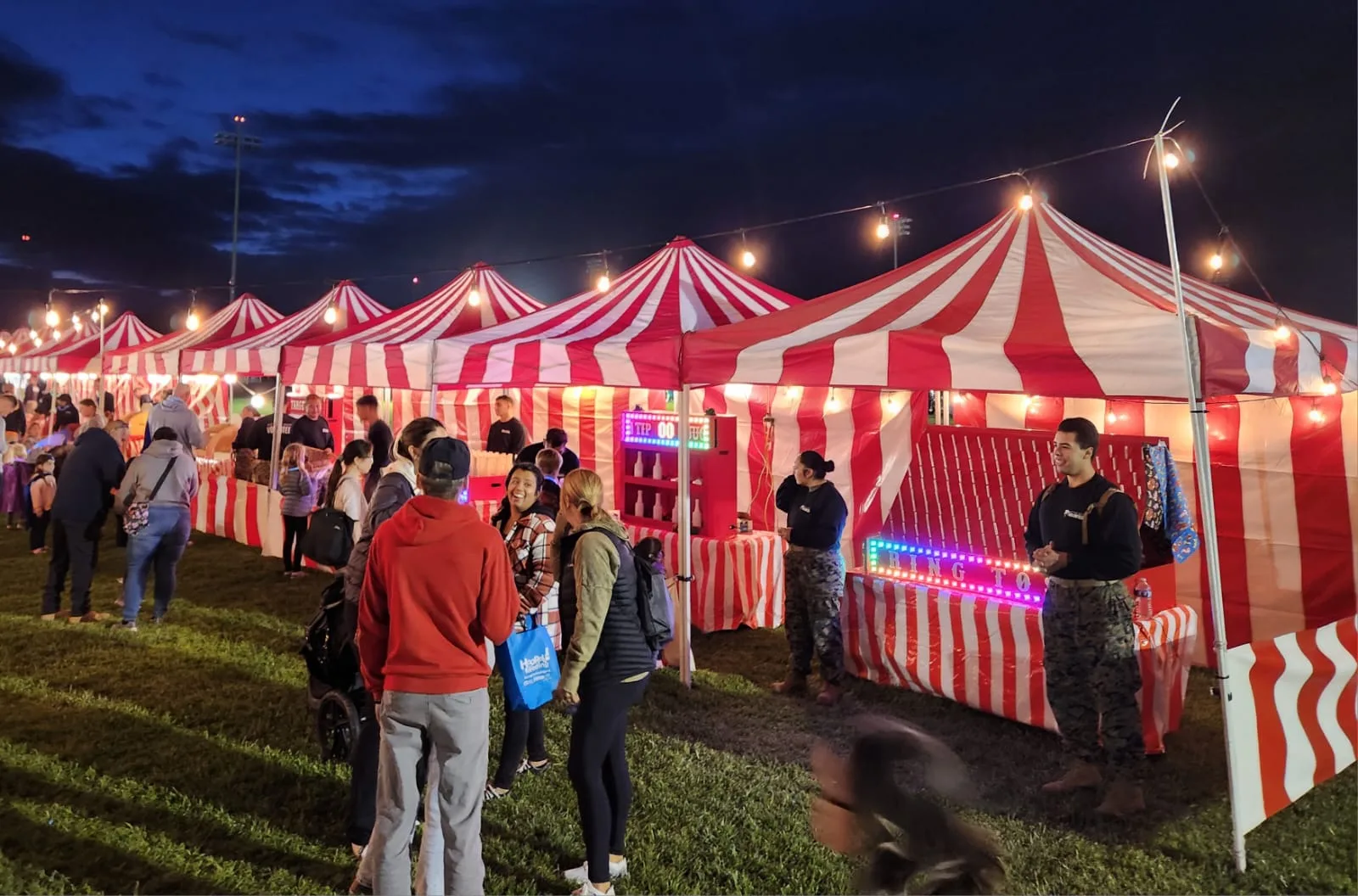
A hundred families showing up is a modest turnout; four hundred-plus is a big one for a PB campus. The available blacktop or asphalt play yard gets sectioned into a compact horseshoe or straight-line layout — striped booths along a fence line or wall, concession machines clustered near whatever shade the campus has, and a ticket table positioned close to the main gate so arriving families can buy in before wandering further onto campus.
The PTA usually handles ticket sales, volunteer scheduling, and the prize redemption table; My Little Carnival brings the booths, games, concession equipment, and an optional trained attendant per station so volunteers aren't learning game mechanics mid-event. Most PB carnivals run either a ticket-strip model (kids buy a strip and spend one per game) or an unlimited-play wristband, priced in the mid-$20s to low-$30s. Wristbands keep lines moving on tighter blacktops; tickets tend to lift per-family spending.
What's typically included.
-
Striped game booths.
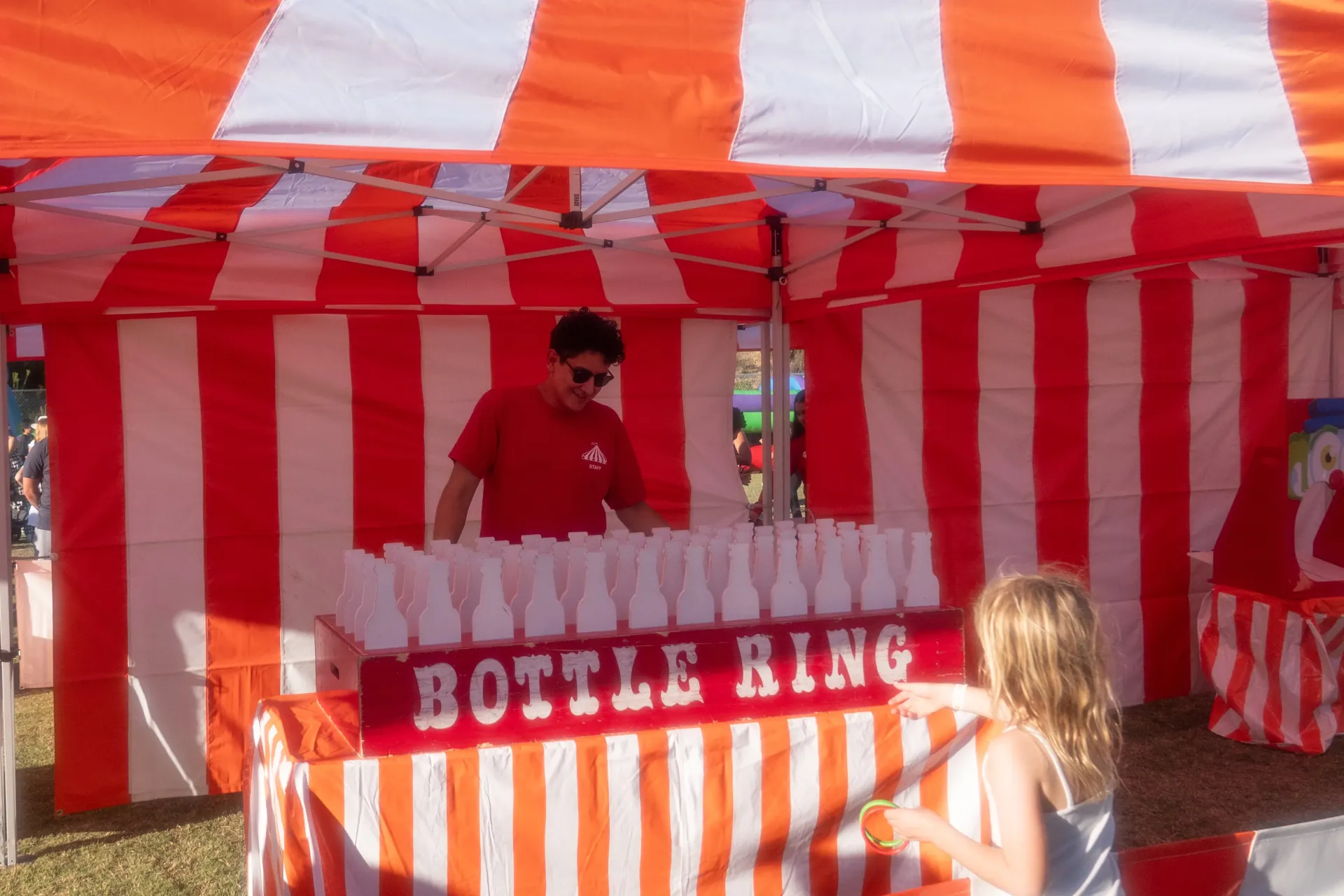
Four to ten traditional carnival booths depending on scope — high-peak red-and-white tents with signage, prize displays, and full skirting, sized to fit a compact blacktop layout.
-
Carnival games + prizes.
Ring toss, bottle knockdown, plinko, balloon pop, fishing pond — each booth comes pre-loaded with consolation and top-tier prizes matched to the booking size.
-
Concession stations.
Popcorn poppers, cotton candy spinners, snow cone shavers — sized to the expected guest count with all supplies, scoops, bags, and cones included.
-
Trained attendants.
One staff member per booth and concession station. PTA volunteers handle ticket sales and prize redemption; everything else is staffed by the production crew.
-
Setup and breakdown.
Crew arrives roughly two hours before doors open and packs out within an hour after the event ends, with no volunteer lifting required.
-
Permits and COI.
My Little Carnival provides the Certificate of Insurance naming the school district as additional insured, which San Diego Unified requires as part of its facility-use process.
Typical timeline for school carnivals in Pacific Beach.
- 1
8-12 weeks out
The PTA committee picks a date, confirms internal use of the campus, and gathers a few quotes. Fall fests get planned starting in late summer; spring carnivals get planning going right after winter break.
- 2
4 weeks out
Scope is locked — booth count, concession lineup, prize tier. Flyers go home, ticket presale opens if the PTA runs one, and a deposit holds the date with My Little Carnival.
- 3
Week of
Final headcount estimate, a quick walk-through of the layout with the production lead, and any remaining facility-use paperwork submitted through the school office.
- 4
Event day
Crew arrives early, sets up over roughly two hours, runs the event for the contracted window, and packs out same-day. Ticket sales and prize redemption stay a PTA-volunteer job.
Specifics for Pacific Beach.
- District paperwork: San Diego Unified requires a facility-use application and a vendor COI naming the district as additional insured. This usually routes through the school office about a month out from the event.
- Campus footprint: Pacific Beach campuses tend to run smaller than inland San Diego schools. A four-to-six booth layout fits most blacktop play areas comfortably; larger carnivals sometimes spread into an adjoining field or use a straight-line booth arrangement along a fence instead of a full horseshoe.
- Power access: Concession machines each need a dedicated circuit. My Little Carnival brings a generator when a campus's outdoor outlets can't cover the load, which is common on older PB school buildings without dedicated event power.
- Ticket vs. Wristband: Tight PB blacktops favor wristbands for keeping lines moving, though ticket-strip models remain common where the PTA wants the added food and game revenue that per-play pricing tends to generate.
- Off-campus alternatives: PTAs wanting more room than a campus allows have looked at Kate Sessions Memorial Park, Palisades Park, and the Pacific Beach Recreation Center. Each requires a separate City of San Diego park-use permit in addition to any school authorization.
- Coastal weather: Southern California's typically dry climate keeps outdoor carnival dates low-risk, though Pacific Beach mornings often carry a marine layer that burns off by midmorning — worth factoring into an early setup call for a morning event.
Common questions.
How early should we book the carnival?
Fall fests booked for October usually lock in by summer; spring carnivals fill up by late winter. Saturday dates in spring and fall are tightest — earlier inquiries get more flexibility on layout and time slot.
What does a deposit hold, and how much is it?
A signed contract plus a deposit, typically 25-35% of the quote, holds the date. The remaining balance is invoiced after the event. Many PTAs cover the deposit from prior-year rollover funds.
Tickets, wristbands, or both?
Both work. Wristbands move lines faster on a tight blacktop; tickets tend to generate more per-family spending because food purchases stack on top. Some PB PTAs run a hybrid — wristbands for games, cash for concessions.
How many booths do we actually need?
A rough guide: one booth per fifty guests for steady play, one per thirty for shorter lines. A 150-guest carnival runs fine on four booths plus concessions; a 400-guest event needs eight or more.
Do we need to provide anything beyond volunteers?
Tables and chairs for ticket sales and prize redemption usually come from the school. Volunteers run those tables and any added food; My Little Carnival brings the booths, games, machines, prizes, and attendants.
Can we run the carnival at a park instead of on campus?
Yes — Kate Sessions Memorial Park and Palisades Park have both hosted community-style carnivals. It requires a City of San Diego park-use permit separate from any school paperwork, and typically more lead time to secure.
About this guide.
This local guide was compiled by My Little Carnival, the San Diego County operation of My Little Carnival — producers of school carnivals, backyard birthdays, and community events across the region.
Helpful local references: San Diego Unified School District · City of San Diego Park and Recreation Department
School Carnivals in nearby cities.
Planning a school carnival in Pacific Beach?
Share the date, expected guest count, and rough budget — and My Little Carnival will scope a quote sized for your campus and ticket model.
Get a quote →