
school carnivals in Carmel Valley.
A school carnival is an on-campus fundraising event, usually three to four hours long, built around carnival game booths, concession machines, and a ticket-or-wristband economy that funds a chunk of the PTA's budget for the year. Equipment arrives the morning of, trained attendants run the booths, and parent volunteers handle ticket sales and prize redemption. Carmel Valley PTAs tend to run one a year — a fall fest in October or a spring carnival between March and May — and the format has stayed consistent enough across San Diego County that there's a pretty standard template to plan around. This is a local guide to school carnivals in Carmel Valley — how they're typically organized, where they happen, and what tends to come up during planning.
Carmel Valley's elementary schools fall under Del Mar Union School District, while middle and high school students feed into San Dieguito Union High School District. Most carnivals happen directly on campus — blacktop courts, upper fields, or the patio outside the multipurpose room — though a few PTAs with larger guest lists or tighter campus footprints move the event to Carmel Valley Community Park, which has open turf and a recreation center that can anchor a rain-contingency indoor space.
My Little Carnival produces school carnivals for elementary and middle school PTAs across coastal and inland San Diego County, with a number of Carmel Valley bookings repeating from one year to the next.
How a school carnival actually unfolds in Carmel Valley.
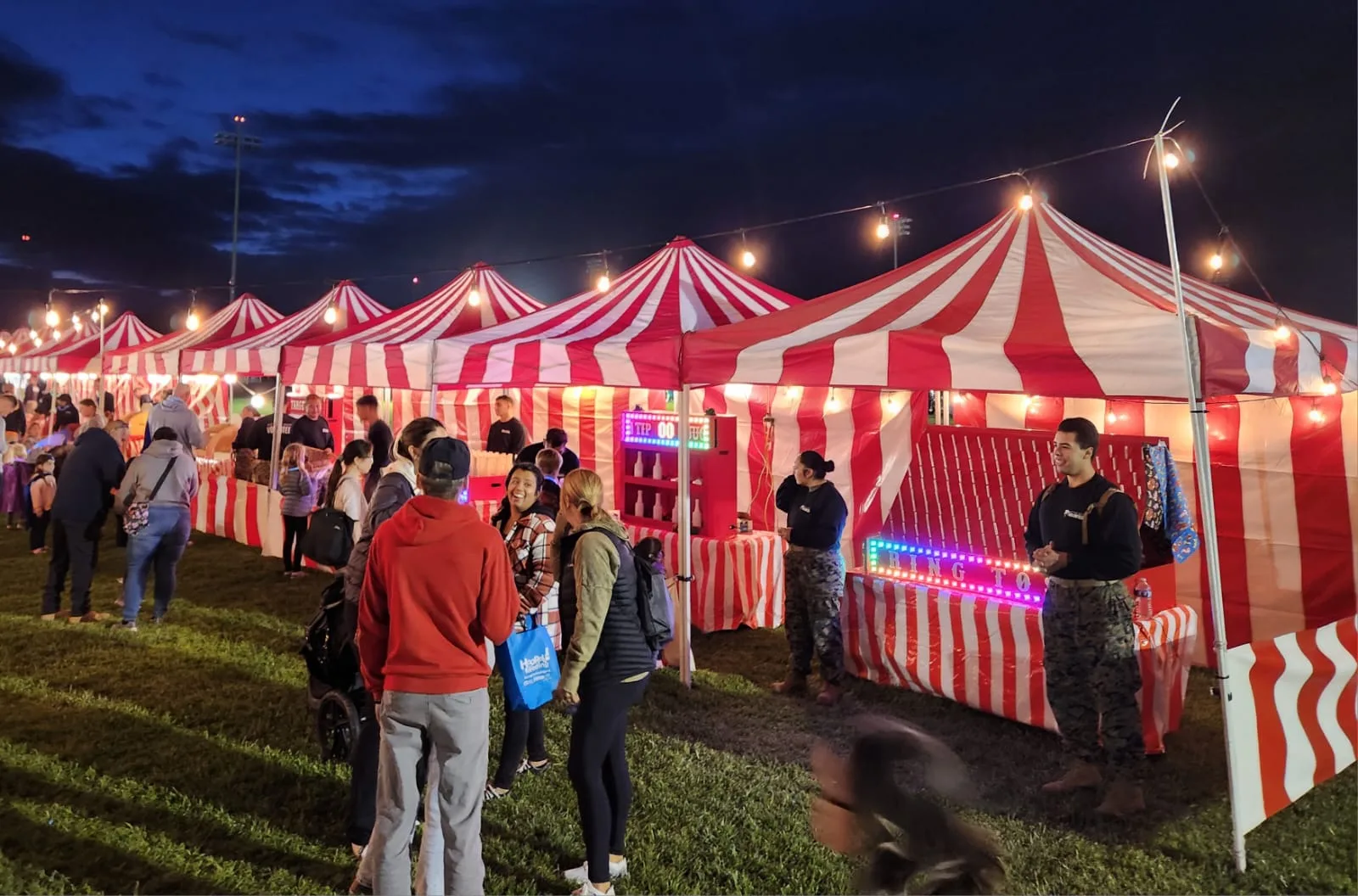
Guest counts run anywhere from a couple hundred families at a smaller DMUSD elementary campus up to several hundred at a larger fall fest. The blacktop or field area typically gets arranged into a horseshoe or straight-line layout — striped booths along the edges for games, concession machines clustered near shade or a covered walkway, a prize table at one end, and ticket sales at the entrance closest to drop-off parking. Kindergarten and first-grade families usually move through earlier in the window; older grades and siblings tend to arrive later and stay longer.
The PTA typically handles ticket sales, volunteer scheduling, and the prize table; My Little Carnival brings the booths, the games, the concession equipment, and an optional attendant per station so volunteers aren't figuring out plinko mechanics mid-event. Carmel Valley PTAs split fairly evenly between a ticket-strip model (kids buy a strip of tickets and spend one per game) and an unlimited-play wristband, usually priced around $25-30. Tickets tend to push higher average spend per family; wristbands move lines faster and feel simpler at the gate.
What's typically included.
-
Striped game booths.
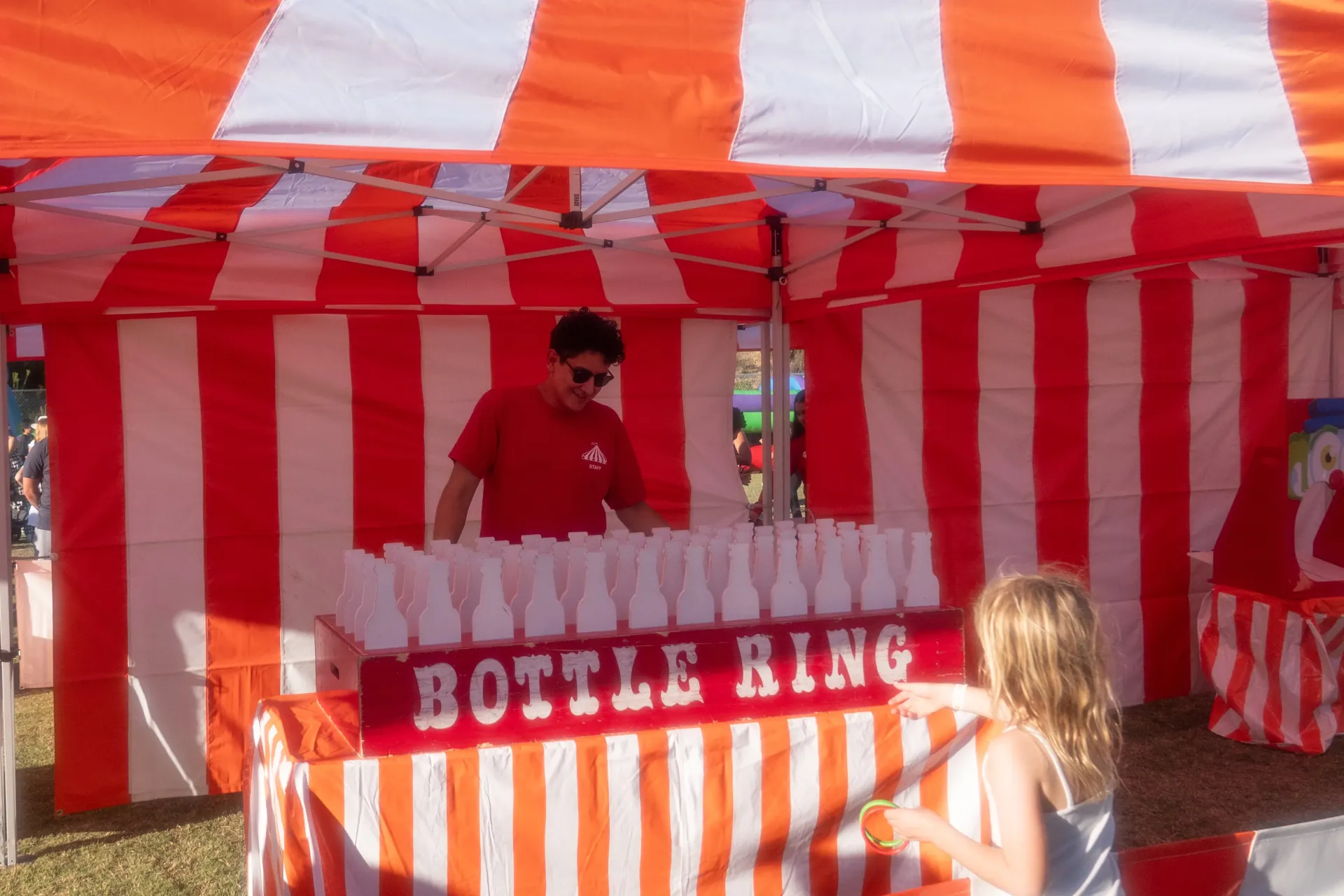
Six to twelve traditional carnival booths depending on scope — high-peak red-and-white tents with signage, prize displays, and full skirting.
-
Carnival games + prizes.
Ring toss, bottle knockdown, plinko, balloon pop, fishing pond — each booth arrives pre-loaded with consolation and top-tier prize inventory sized to the booking.
-
Concession stations.
Popcorn poppers, cotton candy spinners, snow cone shavers — sized to the expected guest count, with all cups, bags, scoops, and cones included.
-
Trained attendants.
One staff member per booth and concession station. PTA volunteers cover ticket sales and prize redemption; the rest is staffed by the production crew.
-
Setup and breakdown.
Crew arrives roughly two hours before doors open and packs out within an hour after the event ends. No volunteer lifting required — the blacktop or field is left as it was.
-
Permits and COI.
My Little Carnival provides a Certificate of Insurance naming the school district as additional insured, which DMUSD and SDUHSD both require for facility-use approval.
Typical timeline for school carnivals in Carmel Valley.
- 1
8-12 weeks out
The PTA committee picks a date, secures internal facility-use approval, and collects a couple of quotes. Fall fest planning generally kicks off in August; spring carnival planning starts around January.
- 2
4 weeks out
Scope gets locked — booth count, concession lineup, prize tier. Flyers go home, ticket presale opens, and volunteer signups get posted. A deposit holds the date with My Little Carnival.
- 3
Week of
Final guest-count confirmation, a layout walk-through with the production lead, and any remaining paperwork submitted through the district's facility-use process.
- 4
Event day
Crew arrives early morning, sets up over roughly two hours, runs the event for the contracted window, and packs out same-day. Ticket sales and prize table stay a PTA-volunteer job.
Specifics for Carmel Valley.
- District paperwork: Del Mar Union School District and San Dieguito Union High School District both require a vendor COI naming the district as additional insured. The facility-use request usually routes through the school office about four weeks ahead.
- Campus footprint: Most DMUSD elementary campuses have a blacktop or hard-court area that comfortably fits a 6-10 booth layout. Larger events sometimes spread onto an adjacent field; tighter campuses stay closer to the multipurpose room patio.
- Power access: Cotton candy spinners and popcorn poppers each need a dedicated circuit. My Little Carnival brings a generator when outdoor outlet access won't cover it, which is common on campuses without a dedicated event hookup.
- Ticket vs. Wristband: Carmel Valley PTAs are fairly split. Wristbands simplify the gate and flatten lines; tickets create a per-game spending pattern that tends to lift both game and concession revenue.
- Off-campus option: Carmel Valley Community Park, with its open turf and the Carmel Valley Recreation Center nearby, has served as a fallback venue for PTAs that outgrow their own campus or want an indoor rain option.
- Weather contingency: Southern California's typically dry climate keeps outdoor carnival dates fairly low-risk, but spring carnivals in March or April occasionally run into a wet Saturday. Most PTAs build a one-week rain date into the contract rather than planning an indoor move.
Common questions.
How far ahead should we book?
Fall fests in October are usually booked by July; spring carnivals book by January or February. Saturdays in April and October are the tightest, so earlier inquiries get more flexibility on layout and time slot.
How much is the deposit, and what does it cover?
A signed contract plus a deposit — typically 25-35% of the quote — holds the date. The remaining balance is invoiced after the event. Many PTAs cover the deposit from summer rollover funds or front it against ticket presale.
Tickets, wristbands, or both?
Either works fine. Wristbands (roughly $25-30 for unlimited play) simplify the gate and speed up lines. Tickets (about $1 per play) tend to generate more revenue per family once food purchases stack on top. Some PTAs run a hybrid model.
How many booths does our school need?
Rough guidance: one booth per fifty expected guests keeps play steady; one per thirty keeps lines short. A 200-guest event runs fine on 4-5 booths plus concessions; a 500-guest event usually needs 8-12.
What does the PTA need to supply?
Tables and chairs for ticket sales and prize redemption usually come from the school. Volunteers handle ticket sales, prize redemption, and any food the PTA adds separately (pizza, drinks). My Little Carnival brings the booths, games, machines, prizes, and attendants.
Can prizes and concessions be adjusted for allergies?
Popcorn, cotton candy, and snow cones are the standard concession lineup and are nut-free by default. PTAs wanting a stricter allergen guarantee should flag it when requesting a quote so prize inventory can be screened to match.
About this guide.
This local guide was compiled by My Little Carnival, the San Diego County operation of My Little Carnival — producers of school carnivals, backyard birthdays, and community events across the county.
Helpful local references: Del Mar Union School District · San Dieguito Union High School District
School Carnivals in nearby cities.
Planning a school carnival in Carmel Valley?
Share the date, expected guest count, and rough budget — and My Little Carnival will scope a quote sized for your campus and ticket model.
Get a quote →