city + municipal events in Mission Hills.
A city or municipal carnival event is a publicly organized celebration produced through a city's parks and recreation department, a council office, or an official community-events calendar, rather than a private host or a school PTA. In Mission Hills, that usually means partnering with the City of San Diego's Parks & Recreation Department on programming that lands at Presidio Park or Pioneer Park: a citywide festival, a Fourth of July family day, a holiday tree-lighting with a carnival add-on, or a parks-and-rec summer program's closing celebration. The footprint runs considerably larger than a school carnival or a backyard party, typically several hundred to a couple thousand guests across a four-to-eight-hour public event window, with vendor authorization, insurance, and sometimes a formal bid process standing between the idea and opening day. A carnival production supplies the midway itself, game booths, concessions, prizes, and the attendants to run all of it, while city staff and any co-sponsoring community group handle permitting, traffic, and the rest of the festival footprint. This is a local guide to City + Municipal Events reaching Mission Hills, how the City of San Diego typically structures them, and what a full-scale production includes.
Mission Hills sits inside the City of San Diego rather than governing its own parks department, so citywide festivals and parks-and-rec programming reaching the neighborhood route through the city's central Parks & Recreation Department rather than a local city hall. Presidio Park, with its open lawn near the Junípero Serra Museum, is the site with enough acreage and vehicle access for a full-scale public festival or a Fourth of July family day; Pioneer Park's smaller green handles a tighter parks-and-rec event or a neighborhood tree-lighting. Inspiration Point, tucked inside Presidio Park, adds a scenic overlook for smaller citywide programming that doesn't need the full open-lawn footprint. San Diego Unified School District campuses in the neighborhood sometimes co-host closing celebrations for city-run summer programs, which brings school facility coordination into the same planning conversation as the park permit.
My Little Carnival produces citywide and municipal carnival events across San Diego County, with experience coordinating alongside city parks staff, council offices, and contracted event producers on public festivals reaching Mission Hills and the broader Uptown area.
How a city or municipal event unfolds in Mission Hills.
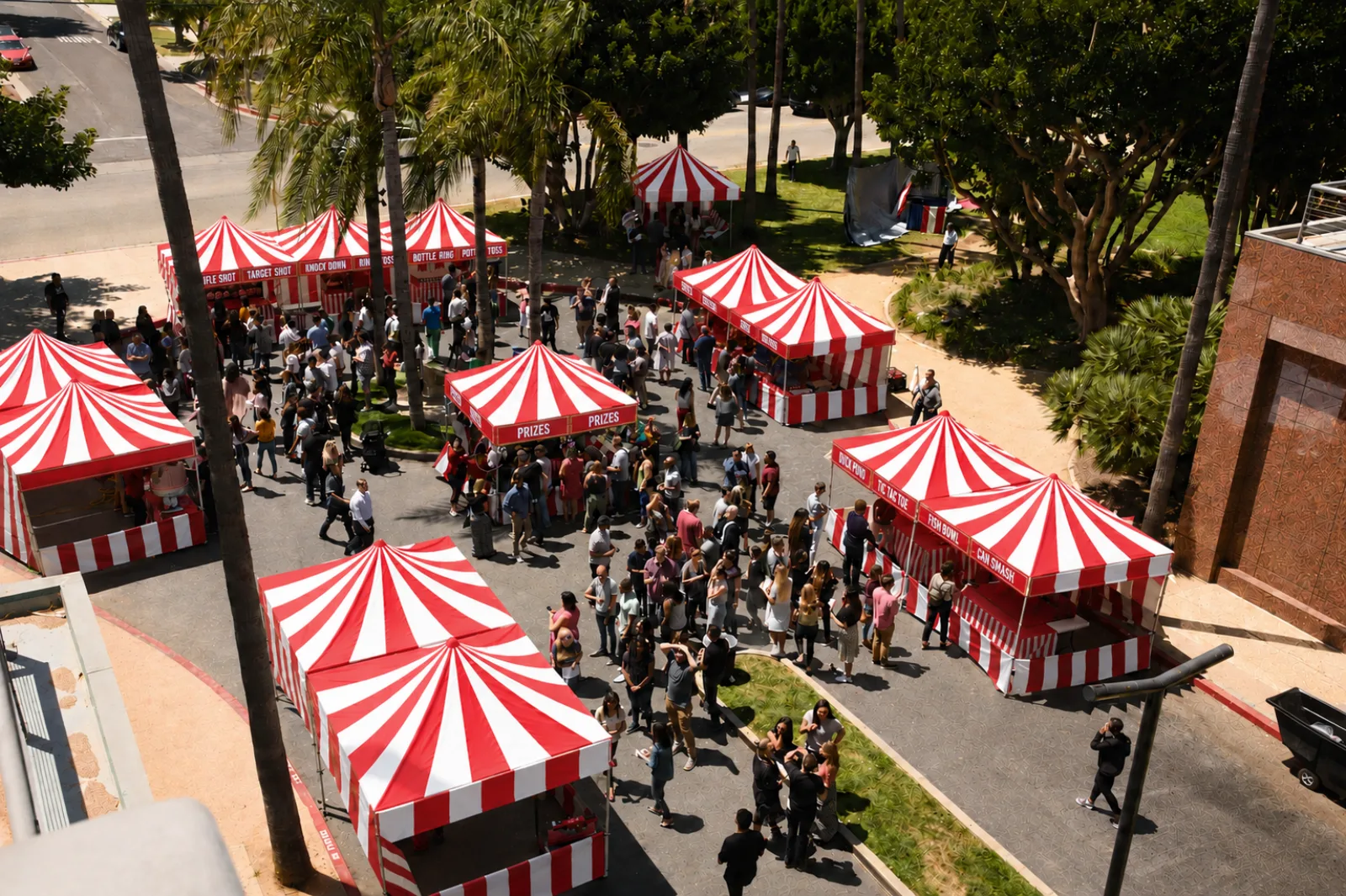
A citywide festival or parks-and-rec family day routed through Presidio Park's open lawn typically occupies a defined section near the main pedestrian approach, since the park's vehicle access matters for load-in at this scale. The carnival footprint lays out as a horseshoe or a straight midway row: six to fifteen striped booths depending on the event's public scope, a concession cluster positioned near shade or the primary walkway, and a prize redemption point near the exit. City staff, a council office representative, or a contracted event producer manages the broader festival, stage programming, vendor rows, traffic control, while the carnival crew runs its section as a self-contained operation with its own production lead.
Pioneer Park's tighter footprint fits a smaller parks-and-rec event or a neighborhood tree-lighting with a carnival add-on: two to six booths, a single concession station, and a compact layout suited to the park's narrower green. Either scale follows the same coordination pattern. My Little Carnival assigns a production lead who checks in directly with the city's event coordinator or council-office liaison throughout the day, so booth staffing decisions and any mid-event adjustments run through one point of contact rather than through individual attendants.
What's typically included.
-
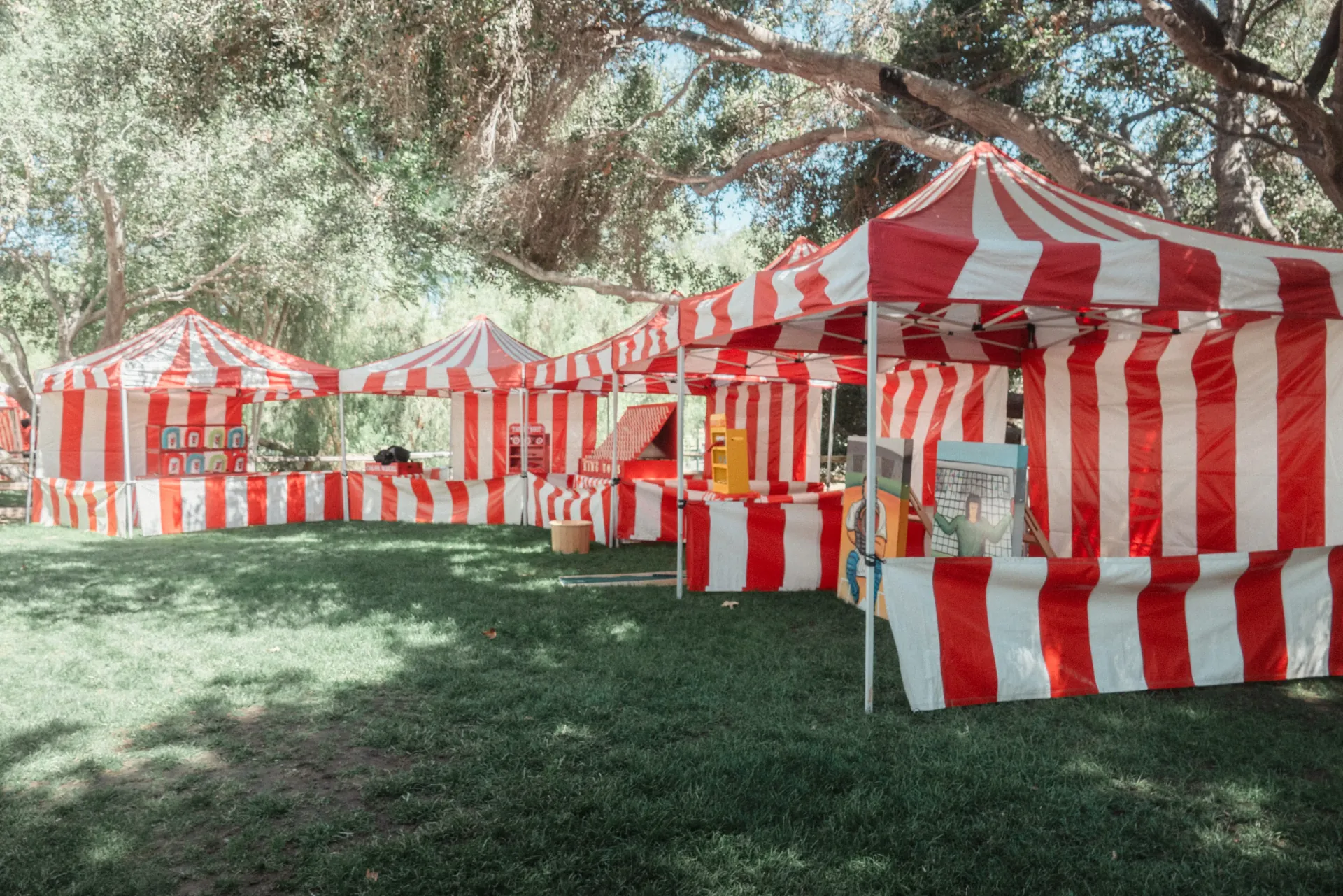
Striped game booths at public-event scale.
Six to twenty high-peak red-and-white booths depending on the event footprint, laid out as a midway row or horseshoe to match Presidio Park's open lawn or Pioneer Park's tighter green. Each booth arrives pre-skirted with signage and prize displays.
-
Carnival games and prize inventory.
Classic midway games, ring toss, bottle knockdown, plinko, balloon pop, basketball pop, with prize inventory scaled to the booking size and the age range a citywide event typically draws. Consolation and top-tier prizes both included and restocked through the event window.
-
Concession stations.
Popcorn poppers, cotton candy spinners, and snow cone shavers in a quantity matched to expected public attendance. Supplies, packaging, and consumables are included for the contracted window, no city staff time required to run them.
-
Trained attendants.
One attendant per booth and concession station for the full event window, plus a production lead on-site who coordinates directly with the city's event manager or council-office liaison and handles mid-event decisions.
-
Setup, strike, and logistics.
Crew arrives several hours before the event opens for full setup; strike begins immediately after the public window closes. All equipment transport, load-in, and load-out is handled by the production team, and the park is left as found.
-
Certificate of Insurance.
My Little Carnival provides a COI naming the City of San Diego and any required co-sponsors as additional insured, standard for the city's park-use and vendor authorization process before a public event date is confirmed.
Typical timeline for city + municipal events in Mission Hills.
- 1
12-16 weeks out
City departments, council offices, or event committees typically begin vendor outreach at this stage. Scope gets discussed, booth count, concession lineup, layout preferences, and a quote is prepared. Public-event procurement sometimes requires vendor registration or multiple bids; starting this early leaves room for those steps without compressing the production timeline.
- 2
6-8 weeks out
Scope is locked, contract signed, deposit paid. COI is issued naming the City of San Diego and any required additional insureds. The park-use permit and vendor authorization paperwork should be moving on the city's end by this point.
- 3
Week of
Final guest-count confirmation, a park layout walk-through with the production lead, power access verified, generator logistics confirmed since Presidio Park and Pioneer Park don't carry dedicated outdoor circuits sized for full carnival load. A rain contingency is confirmed for winter or early-spring dates.
- 4
Event day
Crew arrives three to five hours before the event opens depending on scope. Booths are set, concessions pre-heated, attendants briefed before the first guest arrives. The production lead stays reachable to the city coordinator throughout; strike begins immediately after the window closes.
Specifics for Mission Hills.
- Venue load-in logistics: Presidio Park's vehicle access to its main lawn matters at this scale, a twelve-to-twenty booth production needs multiple truck runs timed around the park's access roads. Pioneer Park's smaller footprint and narrower approach favor a more compact booth count.
- Power at Mission Hills parks: Concession machines and any inflatable blowers pull real amperage, and neither Presidio Park nor Pioneer Park carries dedicated outdoor circuits rated for a full carnival load. My Little Carnival typically brings a generator array for events beyond a minimal booth count, standard practice that gets factored into the site plan submitted to the city's parks department.
- City of San Diego procurement: Citywide festivals and council-sponsored events may require formal vendor registration, W-9 submission, or purchasing-department approval before a contract executes. Starting outreach twelve to sixteen weeks ahead builds in buffer for those steps. Closing celebrations tied to San Diego Unified School District summer programs follow a parallel facility-authorization path.
- Streets and access: Mission Hills' residential streets, especially near Washington Street and Goldfinch Street, run narrow with limited parking. Larger public events sometimes route guests toward transit or a satellite lot rather than counting on street parking near either park.
- Hillside climate: Mission Hills sits on hillside terrain with more exposure to afternoon wind than flatter parts of San Diego. Booth staking and tent anchoring account for that gust pattern, and shade planning matters for concession lines during summer citywide festivals.
- Multi-vendor coordination: Citywide festivals in Mission Hills often layer food trucks, craft vendors, sponsor booths, and stage entertainment alongside the carnival footprint. The production lead coordinates load-in sequencing and footprint boundaries with the city's event coordinator to avoid conflicts during setup and strike.
Common questions.
How far in advance do Mission Hills-area city events typically need to book?
Twelve to sixteen weeks is the practical minimum when city procurement is involved, vendor registration and purchasing-department approval take time. Events with a simpler authorization path can sometimes move faster, but earlier outreach gives more room to lock the date, finalize scope, and get COI paperwork to the city ahead of the permit deadline.
What does a COI for a City of San Diego public event typically need to include?
Generally a general liability minimum, often $1M per occurrence and $2M aggregate for public events at this scale, with the City of San Diego named as additional insured and sometimes a co-sponsoring department or council office named as well. My Little Carnival issues the COI once the contract is signed; exact additional-insured language comes from the city's park-use or vendor-authorization documentation.
How many booths does an event with around 1,000 guests need?
Rough guidance, one booth per seventy-five to one hundred guests for steady play with manageable wait times. A 1,000-guest event spread over four to six hours runs comfortably on ten to twelve booths plus a concession row. A compressed programming window, a 90-minute peak instead of a four-hour spread, pushes that number up.
Can the carnival footprint work inside a larger citywide festival?
Yes, this is the most common format. The carnival occupies a defined zone within the larger festival layout; food trucks, sponsor booths, and stage entertainment occupy adjacent sections. My Little Carnival's production lead coordinates load-in sequencing, footprint boundaries, and strike timing with whoever manages the broader event logistics.
What happens if a public event needs to reschedule due to weather?
Rescheduling terms are set in the contract and depend on how far ahead the change is made. Events with a rain-contingency date built into the original park-use permit are in the best position, rebooking a city park for an alternate date can take as long as the original permit process.
Do smaller parks-and-rec bookings, not major festivals, fit this service?
Yes. Smaller-scope bookings, a parks-department family afternoon with 200 to 300 guests, a summer-program closing celebration, a neighborhood tree-lighting, sit in the lower range of this pricing tier. The same COI, vendor authorization, and production process applies; booth count and attendant staffing scale down accordingly.
About this guide.
This local guide to City + Municipal Events reaching Mission Hills was compiled by My Little Carnival, a division of My Little Carnival, producers of public festivals, school carnivals, and community events across San Diego County.
Helpful local references: City of San Diego Parks & Recreation Department · San Diego Unified School District
City + Municipal Events in nearby cities.
Planning a city or municipal event reaching Mission Hills?
Share the event date, expected guest count, venue, and any procurement or bid requirements, and My Little Carnival will scope a production that fits the park footprint and works within the city's vendor authorization process.
Get a quote →