carnival booths in San Diego.
A carnival booth is the striped red-and-white tent structure that gives a carnival its signature look — built in 5x5, 8x8, and 10x10 footprints, with a peaked canopy roof, front counter, and full fabric skirting. The same structure works as a game station, a concession counter, a prize redemption window, a ticket booth, or a photo backdrop, depending on what's loaded inside it. Most school carnivals and corporate carnival events run somewhere between four and fifteen booths arranged around a central walkway. As part of a full event My Little Carnival produces in San Diego, booths arrive built, staffed or ready for volunteer staffing, and stocked with whatever games, prizes, or concession equipment the event calls for — this is a local guide to how they're sized, arranged, and set up around the city.
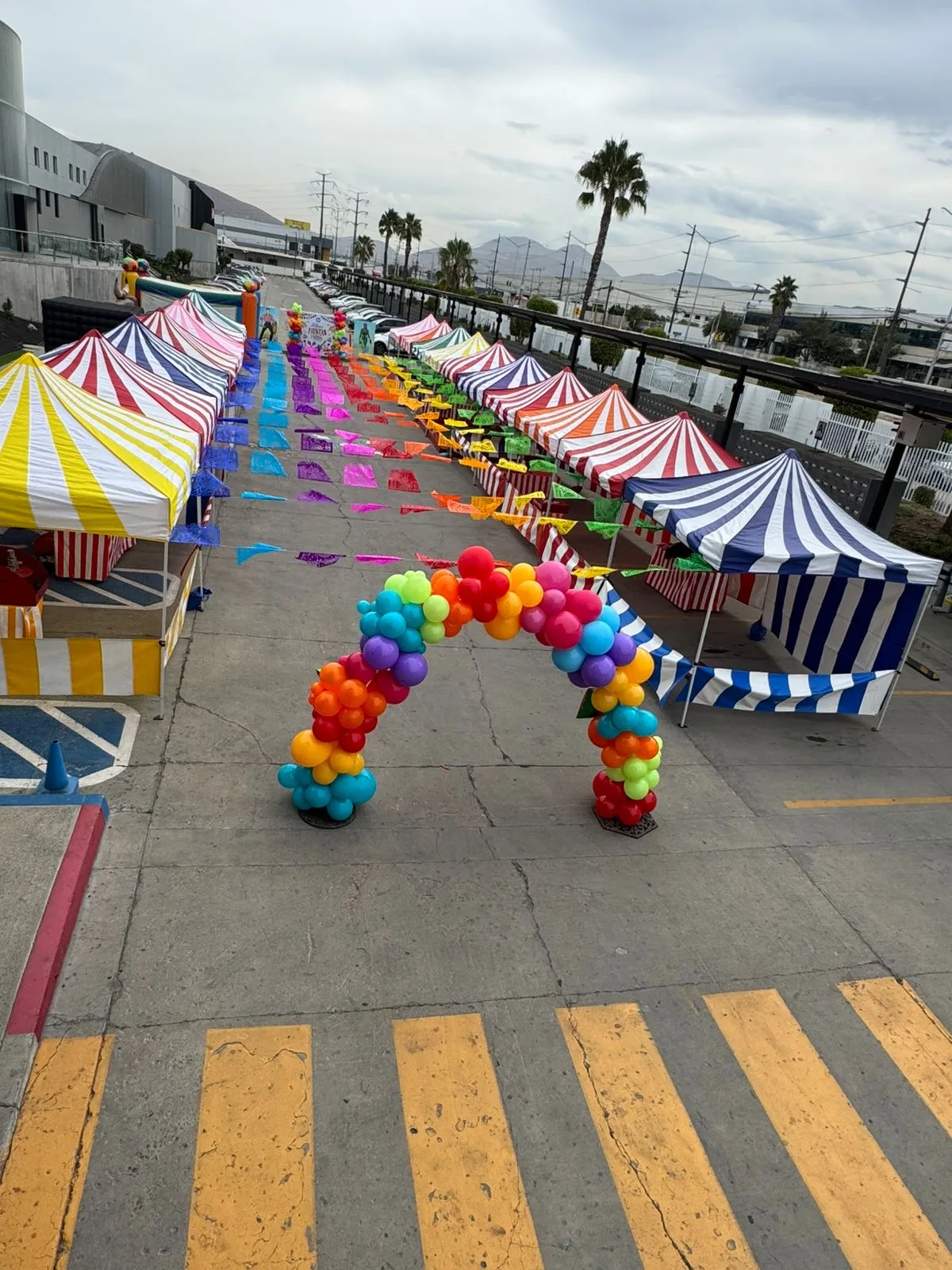
San Diego's carnival bookings run across a wide mix of surfaces — Balboa Park's paved courtyards and lawns, school blacktops within San Diego Unified School District, the open grass of Mission Bay Park, the trailhead-adjacent flats near Mission Trails Regional Park, and paved plaza space around venues like Snapdragon Stadium for corporate and community events. Booth layout adapts to each: a horseshoe on a school blacktop, a straight row along a park pathway, or a wider fan arrangement when a plaza has room to spread out.
My Little Carnival produces carnival events across San Diego County, and the booth lineup — sizing, count, and function — gets scoped to the venue and guest count during the quote.
How carnival booths get arranged inside a full event in San Diego.
On a typical event, booths are grouped into a horseshoe or a straight row so the flow of foot traffic moves naturally from the entrance toward concessions and prizes at the far end. A 5x5 booth suits a single simple game or a ticket-sales window; an 8x8 handles most standard carnival games with room for a prize display; a 10x10 is the concession workhorse, sized for a popcorn popper or cotton candy machine plus a server. Most events mix sizes — a run of 8x8 game booths flanked by one or two 10x10 concession booths and a 5x5 ticket booth near the entrance.
Inside a full My Little Carnival production, the booths themselves are one piece of a larger footprint that also includes prize inventory, signage, and — depending on the package — inflatables or rides nearby. A school carnival on a San Diego Unified campus blacktop might run eight booths in a horseshoe with the concession booths shaded near the multipurpose room; a backyard birthday scales down to two or three booths tucked along a fence line; a corporate event at a larger venue can stretch to fifteen booths across a paved plaza.
What's typically included.
-
Booth structure.
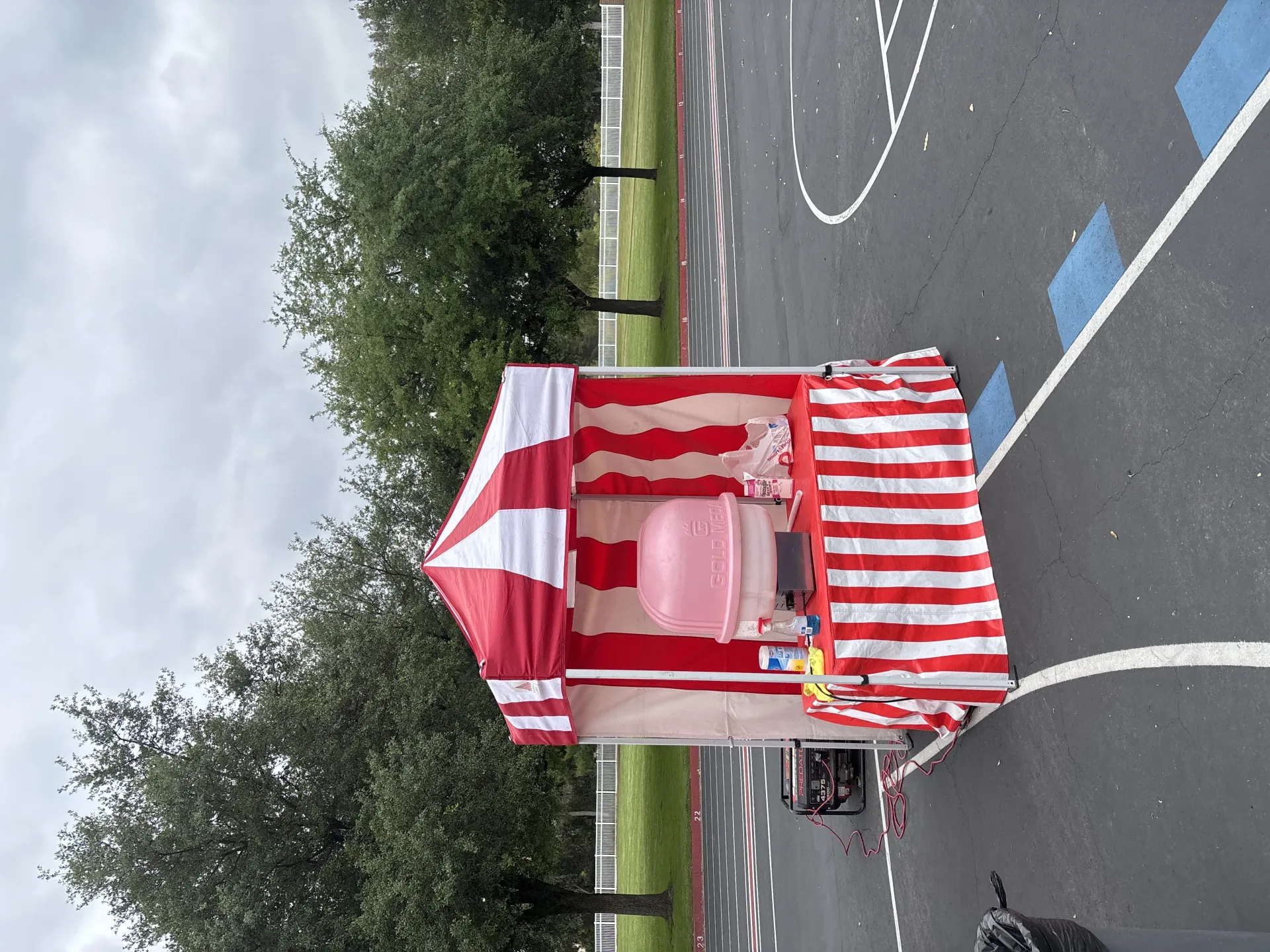
Peaked-canopy striped tent frame with full fabric skirting and a front counter, in 5x5, 8x8, or 10x10 footprints depending on the function assigned to it.
-
Function setup.
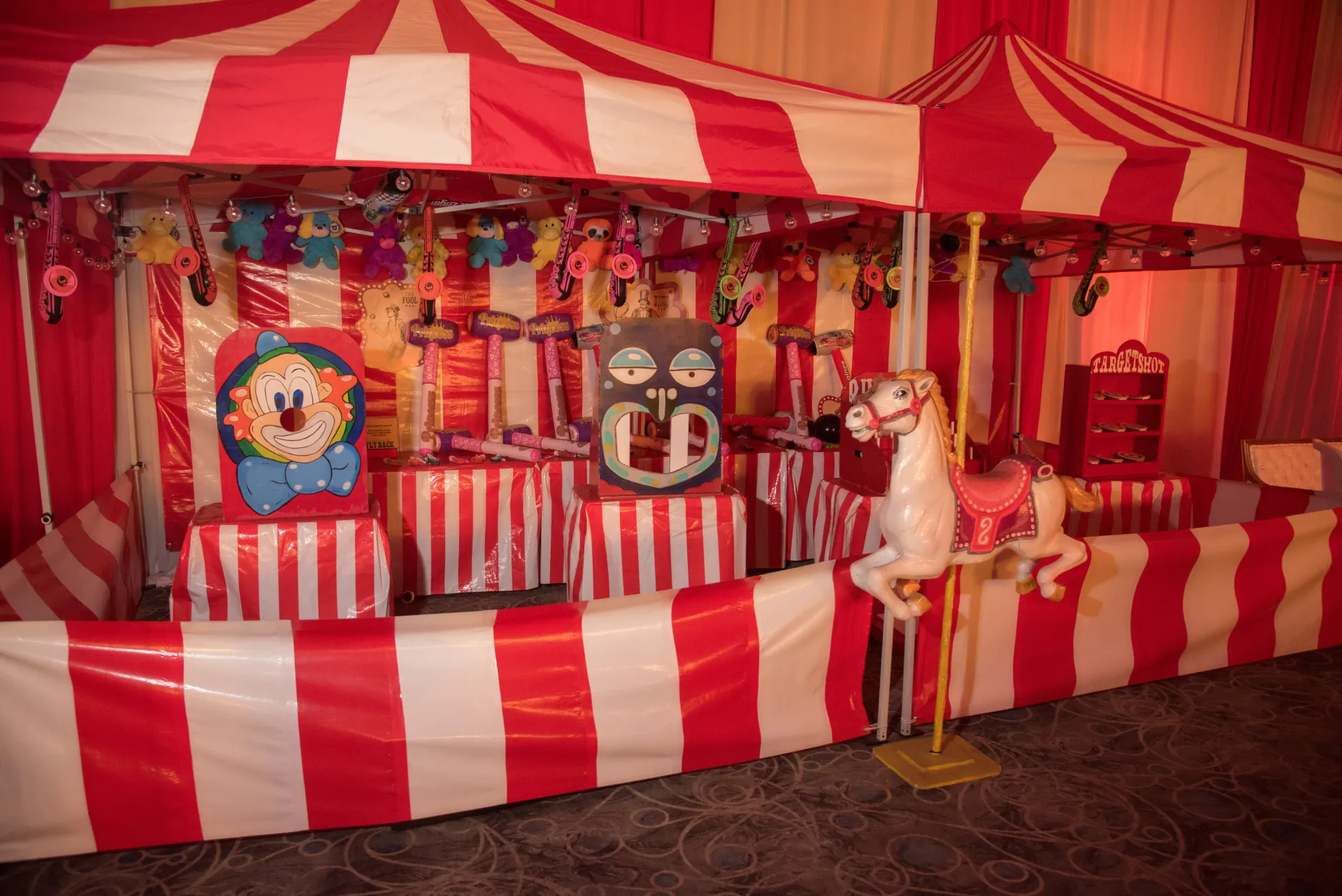
Each booth arrives configured for its role — game equipment and prize rail, concession machine and serving counter, ticket-sales window, or a clean backdrop for photos.
-
Signage and prize display.
Booth-front signage naming the game or item, plus a hanging or shelved prize display sized to the booking.
-
Anchoring for the surface.
Stakes on grass and dirt, sandbag or water-barrel anchoring on asphalt and concrete — matched to the venue during setup.
-
Delivery, setup, and breakdown.
Crew delivers, assembles, and positions every booth as part of the event build, then strikes and hauls out after the event ends.
-
Attendants.
Available as an add-on, quoted per booth or per hour, or volunteer-staffed — game and concession booths are commonly run by parent or staff volunteers, with trained attendants offered where a client wants hands-off operation.
Typical timeline for carnival booths in San Diego.
- 1
Inquire
Share the venue, expected guest count, and rough date. This determines booth count, size mix, and whether concession or ticket functions are needed.
- 2
Quote and booking
Booth count and functions get scoped — for example six 8x8 game booths, two 10x10 concession booths, one 5x5 ticket booth — and a deposit locks the date.
- 3
Delivery and setup
Crew arrives ahead of the event window, builds the booths in the agreed layout, anchors them for the surface, and stocks games, prizes, or concession supplies.
- 4
Event day and breakdown
Booths run for the contracted window — staffed by volunteers, add-on attendants, or a mix — then the crew strikes and hauls out after guests leave.
Specifics for San Diego.
- Surface types: Grass, dirt, asphalt, and concrete all work. Grass and dirt take stake anchoring; blacktop, paved courtyards at Balboa Park, and plaza space near venues like Snapdragon Stadium need sandbag or water-barrel anchoring instead.
- Common venue types: School blacktops within San Diego Unified School District, backyard patios and lawns, and larger park settings like Mission Bay Park and Mission Trails Regional Park for community-scale events.
- Permits: City-owned spaces such as Balboa Park and the Balboa Park Activity Center typically require a park-use or facility permit; school campuses generally require a facility-use authorization and a Certificate of Insurance naming the district or venue as additional insured.
- Power needs: Concession booths — popcorn poppers, cotton candy spinners, snow cone shavers — pull dedicated circuits. My Little Carnival brings a generator when a venue's available outlets won't cover the load, which is common at park and blacktop locations without event hookups.
- Booth count guidance: Loose rule of thumb: one booth per 30-50 expected guests keeps lines manageable. A 150-guest backyard or small campus event runs on 3-5 booths; a 500-guest school carnival or community event scales to 8-15.
- Weather: Southern California's typically dry climate keeps outdoor booth setups low-risk most of the year. Booths are wind-rated for normal conditions but get restaked or struck early if forecasts call for unusually high gusts.
San Diego, CA.
ZIPs: 92101 · 92102 · 92103 · 92104 · 92105 · 92106 · 92107 · 92108 · 92109 · 92110 · 92111 · 92112 · 92113 · 92114 · 92115 · 92116 · 92117 · 92119 · 92120 · 92121 · 92122 · 92123 · 92124 · 92126 · 92127 · 92128 · 92129 · 92130 · 92131 · 92132 · 92134 · 92135 · 92136 · 92137 · 92138 · 92139 · 92140 · 92142 · 92145 · 92147 · 92149 · 92150 · 92152 · 92153 · 92154 · 92155 · 92158 · 92159 · 92160 · 92161 · 92163 · 92165 · 92166 · 92167 · 92168 · 92169 · 92170 · 92171 · 92172 · 92174 · 92175 · 92176 · 92177 · 92179 · 92182 · 92186 · 92187 · 92190 · 92191 · 92192 · 92193 · 92195 · 92196 · 92197 · 92198 · 92199
My Little Carnival delivers carnival booths throughout San Diego and the surrounding San Diego County area. Pin shows the city center; we cover every ZIP listed above.
Common questions.
What sizes do carnival booths come in?
5x5, 8x8, and 10x10. The 5x5 suits simple games or ticket sales, the 8x8 is the standard size for most carnival games, and the 10x10 is sized for concession equipment and a server.
Are attendants included with the booths?
Not by default. Game and concession booths are commonly run by volunteers, and trained attendants are available as an add-on, quoted per booth or per hour, for events that want hands-off operation.
What surfaces can booths be set up on?
Grass, dirt, asphalt, and concrete all work. Grass and dirt use stake anchoring; paved surfaces like a school blacktop or a plaza use sandbag or water-barrel anchoring instead.
Do concession booths need a generator?
Often, yes. Popcorn poppers, cotton candy spinners, and snow cone shavers pull enough power that a venue's standard outlets frequently aren't enough, especially at parks and school campuses without dedicated event power. My Little Carnival brings a generator when needed.
How many booths does our event need?
A loose guide is one booth per 30-50 guests. Smaller backyard events run 3-5 booths; larger school carnivals or community events scale up to 8-15 depending on guest count and how many functions — games, concessions, tickets — are needed.
Do we need a permit to set up booths at a park?
City-owned venues like Balboa Park typically require a park-use or facility permit, and school campuses generally require a facility-use authorization plus a Certificate of Insurance naming the district as additional insured. My Little Carnival can provide the COI as part of booking.
About this guide.
This local guide to carnival booths in San Diego was compiled by My Little Carnival, a division of My Little Carnival, producing carnival events across San Diego County.
Helpful local references: San Diego Unified School District · Balboa Park
Carnival Booths in nearby cities.
Planning booths for a carnival event in San Diego?
Share your venue, guest count, and the mix of games, concessions, or tickets you need — and My Little Carnival will scope a booth layout and send a quote.
Get a quote →