
school carnivals in South Park.
A school carnival is a few hours of on-campus games, concessions, and prizes, usually built around a play-through-tickets-or-wristbands model that raises money for the PTA. In South Park, where campus lots tend to be small and hemmed in by residential streets, carnivals lean tighter and denser than the sprawling versions you see at suburban schools — fewer booths, closer together, with the crowd spilling toward whatever patch of blacktop or field the campus has. This is a local guide to school carnivals in South Park — how they're typically laid out, what the neighborhood's tight footprint means for planning, and what a turnkey production usually includes.
South Park sits within San Diego Unified School District, tucked between Golden Hill and Balboa Park on a grid of narrow residential streets that were never built with event parking in mind. Campus carnivals here work within that reality — smaller footprints, careful attention to street parking and drop-off flow, and sometimes a look toward nearby green space like Grape Street Park when a PTA wants more room than the school lot allows.
My Little Carnival produces school carnivals for elementary and middle school PTAs across the South Park and Golden Hill area, scaling the booth count and layout to whatever space the campus actually has.
How a school carnival actually unfolds in South Park.
Given the neighborhood's older, smaller campuses, most South Park carnivals run on the compact end — a hundred to three hundred guests is typical, not the five-hundred-plus crowds you'd see at a bigger suburban elementary. Booths line whatever blacktop or paved yard the school has, often against a fence line, with concessions tucked near a shaded breezeway. The whole footprint might be half the size of a typical fall fest layout elsewhere in the county, which changes how many booths make sense and how tight the walking lanes need to be.
The PTA runs ticket sales, prize redemption, and volunteer scheduling; My Little Carnival brings the booths, games, concession equipment, and an optional attendant per station so nobody's improvising game rules mid-event. Because parking is already tight around most South Park schools, carnivals here tend to schedule around school pickup times rather than fighting for street space during a separate evening event — Friday afternoon carnivals right after the bell are common.
What's typically included.
-
Striped game booths.
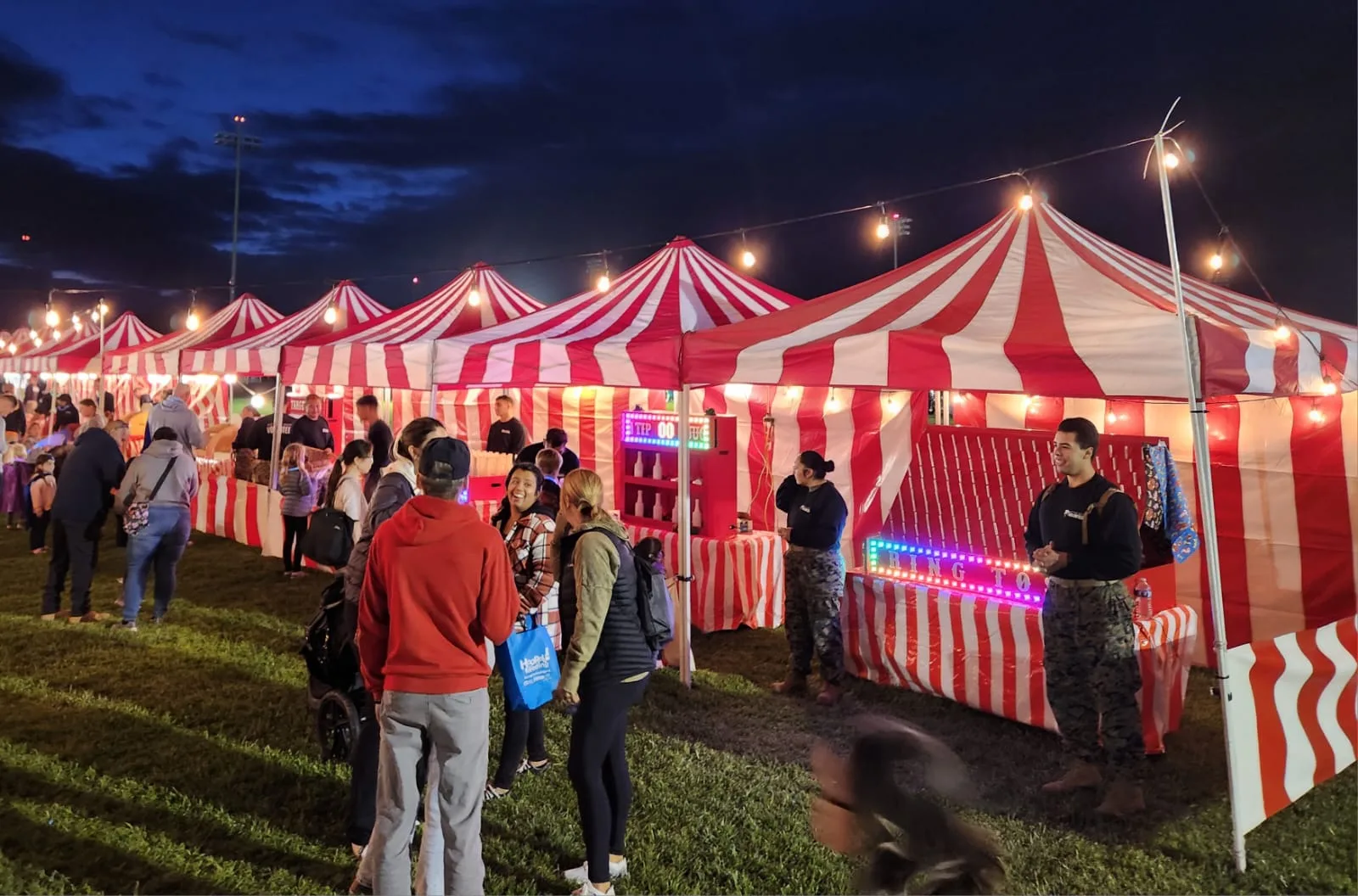
Four to eight booths depending on campus size — high-peak red-and-white tents sized to fit tighter blacktop footprints without crowding walkways.
-
Carnival games + prizes.
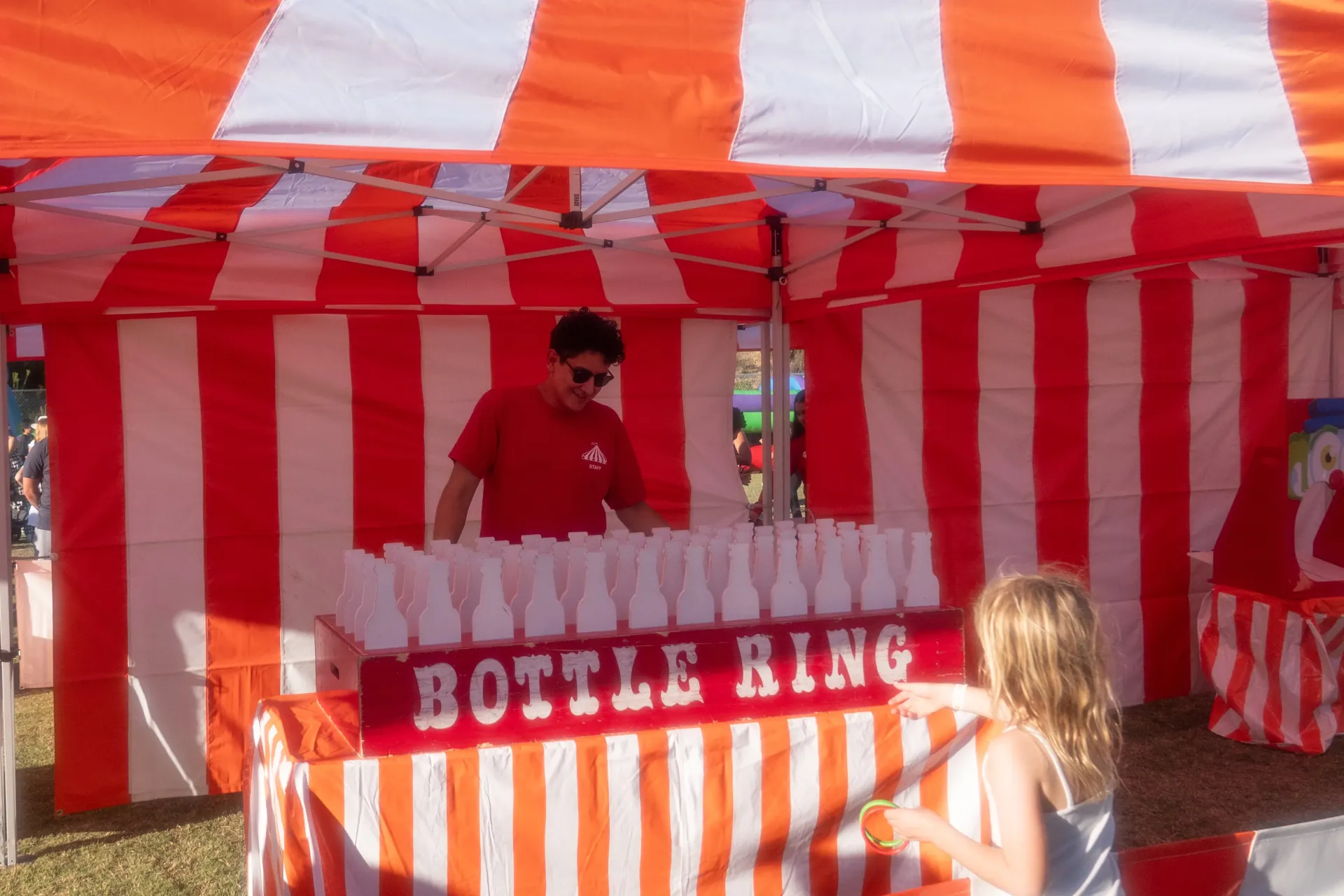
Ring toss, bottle knockdown, plinko, balloon pop, fishing pond — chosen and arranged for smaller lots, each stocked with prize inventory sized to the guest count.
-
Concession stations.
Popcorn poppers, cotton candy spinners, snow cone shavers — compact units that fit under a breezeway or shade structure when open field space is limited.
-
Trained attendants.
One staff member per booth and concession station. PTA volunteers handle ticket sales and prize redemption; the rest is staffed by the production team.
-
Setup and breakdown.
Crew arrives with enough lead time to load in on foot or via a narrow driveway if that's all the campus offers, and packs out within an hour after the event ends.
-
Permits and COI.
My Little Carnival provides the Certificate of Insurance naming the school district as additional insured, which San Diego Unified requires for facility-use authorization.
Typical timeline for school carnivals in South Park.
- 1
8-12 weeks out
PTA committee sets the date, confirms campus availability through the school office, and requests 2-3 quotes. Fall fests get planned over summer; spring carnivals start after winter break.
- 2
4 weeks out
Booth count and concession lineup are locked based on the campus's actual footprint. Flyers go home, ticket presale opens, and a deposit holds the date with My Little Carnival.
- 3
Week of
A short walk-through with the production lead confirms exactly where booths will fit given fencing, breezeways, and any construction or storage that's eating into the yard that week.
- 4
Event day
Crew loads in early, sets up within the confirmed footprint, runs the contracted window, and packs out same-day. Ticket sales and prize redemption stay with PTA volunteers.
Specifics for South Park.
- District paperwork: San Diego Unified School District requires a vendor COI naming the district as additional insured, submitted through the school's facility-use process, typically a few weeks ahead of the event.
- Campus footprint: South Park schools generally run smaller and older than suburban campuses — expect a single blacktop yard or a combined yard-and-field space rather than a large multi-purpose field. Booth counts are planned around that constraint rather than a target guest number.
- Street parking: South Park's residential grid means street parking near most schools is limited on a normal day, let alone during an after-school event. Load-in logistics and any guest overflow parking are worth discussing early with the production team.
- Power access: Concession machines pull a dedicated circuit each. Older campus buildings sometimes have limited outdoor outlet capacity, so My Little Carnival brings a generator when the available power won't cover the concession lineup.
- Off-campus alternatives: When a PTA wants more room than the school yard allows, Grape Street Park and the open lawns near Golden Hill Recreation Center have served as overflow or alternate carnival sites, though each requires its own City of San Diego park-use permit.
- Weather contingency: Southern California's typically dry climate keeps outdoor carnival dates fairly low-risk. Most PTAs still build a rain-date option into the contract for spring events rather than trying to move everything indoors on short notice.
Common questions.
How early should we book a South Park school carnival?
Aim for 8-12 weeks out, especially for spring dates when Saturdays and Friday afternoons fill up fastest. Booking early also gives more room to plan around the campus's specific footprint.
What if our campus yard is really small?
Most South Park campuses run on the smaller side, and package scope is set to match — a 4-booth layout with a couple of concession stations fits comfortably on a single blacktop yard without crowding walkways.
Is parking a real issue for carnival day?
It can be. South Park's narrow residential streets don't offer much extra parking beyond what schools already use. Scheduling right after the school day, when families are already walking or biking in, tends to work better than a standalone evening event.
Can we hold the carnival at Grape Street Park instead of on campus?
Some PTAs choose to move larger events off-campus for more space. Grape Street Park and the grounds near Golden Hill Recreation Center have been used this way, but that requires a separate City of San Diego park-use permit in addition to any school authorization.
How many booths and how much staffing do we actually need?
For a typical South Park elementary carnival of 100-300 guests, 4-6 booths plus one or two concession stations is common. My Little Carnival staffs one attendant per station; PTA volunteers cover ticket sales and prize redemption.
What does the deposit cover?
A signed contract and deposit (typically 25-35% of the quote) holds the date and locks in the booth count and concession lineup. The remaining balance is invoiced after the event.
About this guide.
This local guide was compiled by My Little Carnival, the San Diego County operation of My Little Carnival — producers of school carnivals, backyard birthdays, and community events across Southern California.
Helpful local references: San Diego Unified School District · City of San Diego Parks & Recreation
School Carnivals in nearby cities.
Planning a school carnival in South Park?
Share the date, expected guest count, and your campus's rough footprint — My Little Carnival will scope a quote sized for the space you actually have.
Get a quote →