city + municipal events in University City.
A city or municipal carnival event is a publicly sponsored celebration, a parks-and-rec family day, a citywide festival, a holiday tree-lighting, run by a city department rather than a private host, where a carnival production supplies the midway, striped booths, games, concessions, and the crew to operate them, while parks staff and city coordinators manage the rest of the program. These events read differently from a private party: the guest list is the general public, the paperwork runs through a city department instead of a single family or board, and the footprint typically scales from a modest parks-and-rec afternoon to a citywide festival drawing well over a thousand attendees. This local guide walks through how the City of San Diego's Parks and Recreation Department structures public-event permits, which venues host them, and what a production at civic scale actually includes here in University City.
University City's public events run through the City of San Diego's Parks and Recreation Department, and the department's preferred site for anything beyond a small gathering is Standley Community Park, whose open turf, paved plaza, and adjoining Standley Recreation Center give a city coordinator both an outdoor festival footprint and an indoor fallback for check-in, staging, or a weather contingency. Marian Bear Memorial Park, the canyon park running along Rose Creek, hosts smaller nature-adjacent city gatherings where trail access limits how large a carnival footprint can spread. Families in University City attend school through San Diego Unified School District, and it's common for a city-sponsored family day here to share a calendar with the district's own community nights, since both draw from the same neighborhood.
My Little Carnival produces city-scale carnival events across San Diego County, with experience working alongside city recreation departments and contracted event coordinators on public festivals from a single-department family day to a citywide celebration.
How a municipal carnival event unfolds in University City.
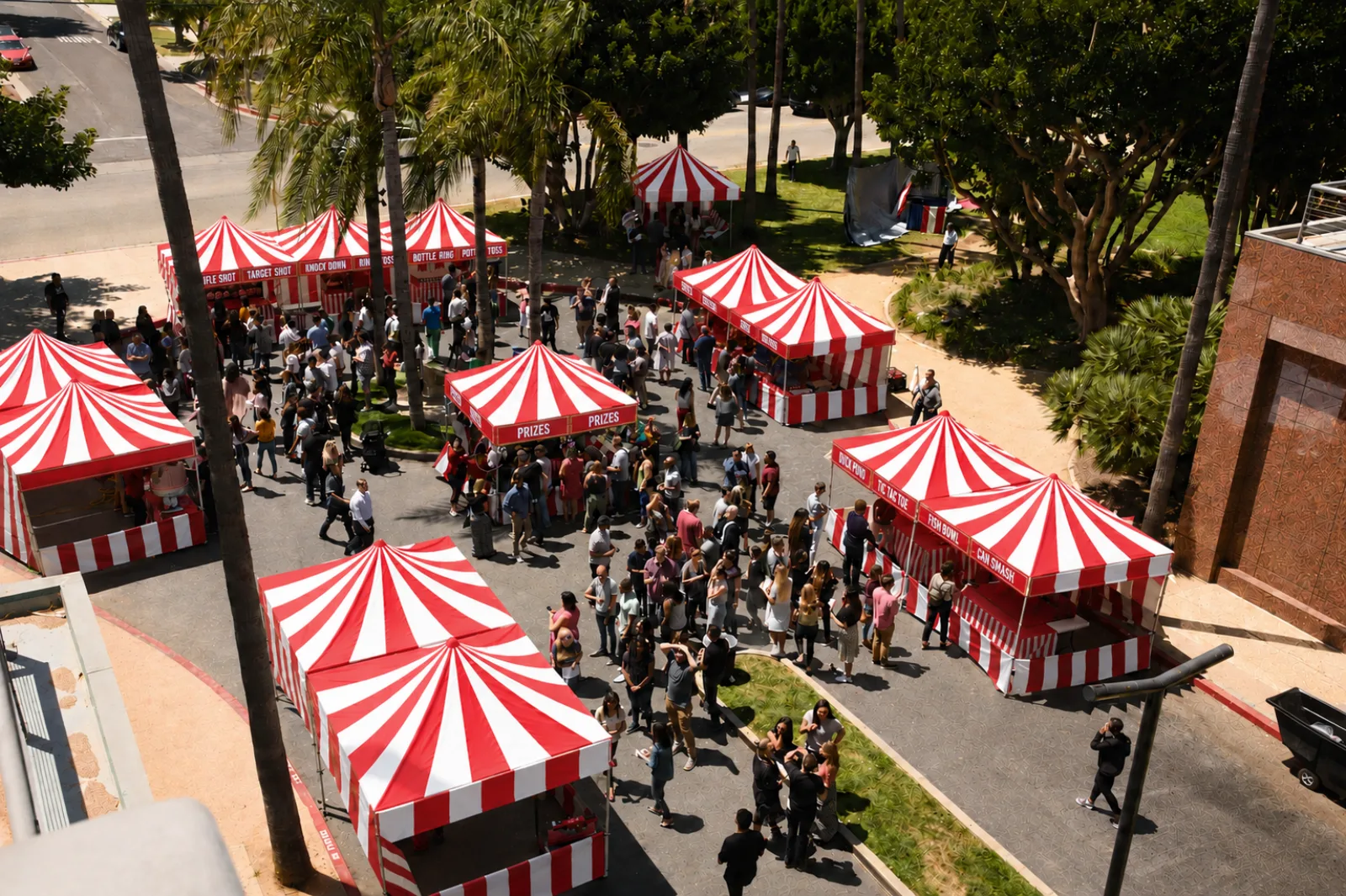
A parks-and-rec family day at Standley Community Park, drawing anywhere from two hundred to a few thousand residents depending on the program, typically claims a defined section of the park's open turf rather than the whole property, since the site often carries other reservations or drop-in recreation programming on the same day. The carnival footprint gets laid out with clear sightlines from the main pedestrian entry: a run of striped booths along one edge, a concession row positioned where foot traffic naturally funnels, and an inflatable zone anchored on the grass with stakes rather than the weighted bases used on the plaza's paved sections. City staff handle the public-facing program, a stage, a proclamation, a vendor row, while the carnival crew runs its zone as a self-contained operation a parks coordinator can check on without managing directly.
Because the guest list is the general public and the venue is public land, the planning process looks different from a private booking. A parks-and-rec event usually needs department sign-off well before a booth is ever ordered, and a larger citywide festival can carry a special-event permit that touches the city's traffic, fire, and facilities departments in addition to parks staff. My Little Carnival assigns a production lead who works directly with the city's event coordinator from the first site walk through strike, so questions about layout, generator placement, or a mid-event adjustment have one point of contact rather than routing through booth-level staff.
What's typically included.
-
Striped game booths at public-event scale.
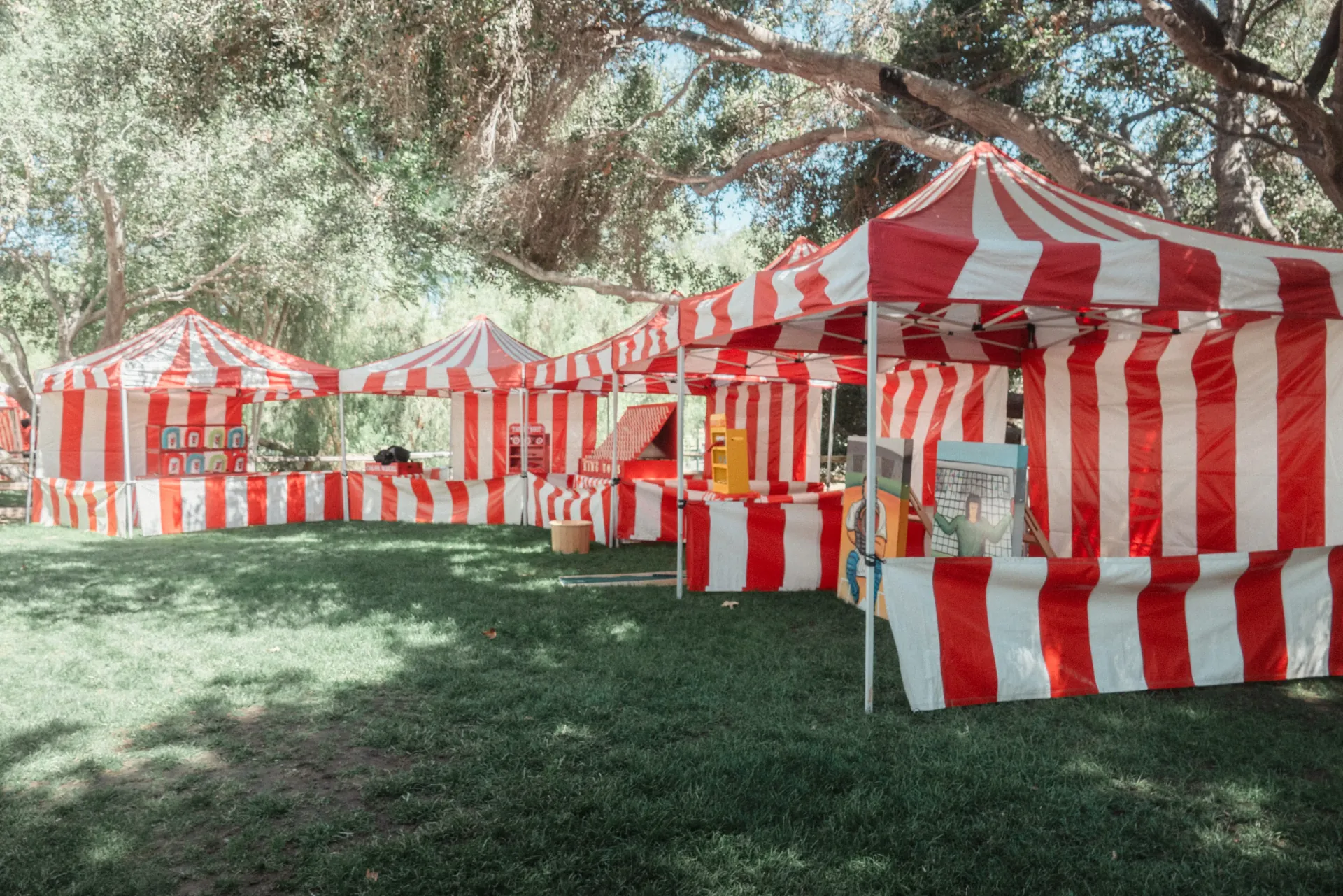
Eight to twenty high-peak booths depending on expected turnout, laid out in a row, horseshoe, or grid to fit the park's open turf or paved plaza. Each booth arrives pre-skirted with signage and a stocked prize rail.
-
Carnival games and prize inventory.
Ring toss, bottle knockdown, plinko, a fishing pond, and similar low-skill games with prize tiers built for a public crowd spanning toddlers to grandparents, restocked through the event window rather than set once at the start.
-
Concessions sized for unpredictable turnout.
Popcorn, cotton candy, and snow cone stations quantified against the department's turnout estimate, with enough buffer built in for a public event where actual attendance is harder to pin down than an RSVP list.
-
City-vendor and COI paperwork ready.
A Certificate of Insurance naming the City of San Diego, and any co-insured department, prepared ahead of the special-event or group-use permit deadline, plus whatever vendor-registration paperwork the city's purchasing process requires.
-
Setup, strike, and site coordination.
Crew arrives several hours ahead of the public start time and clears the site immediately after, coordinating load-in and load-out timing with parks facilities staff so the carnival's schedule doesn't conflict with the department's own teardown or the site's next reservation.
-
A production lead as single point of contact.
One person on-site throughout who liaises directly with the city's event coordinator, so layout questions, weather calls, or mid-event adjustments go through one conversation instead of several.
Typical timeline for city + municipal events in University City.
- 1
3-6 months out
Public-event lead times run long here because department approval, budget sign-off, and, for larger festivals, a special-event permit application all need to clear before a contract is finalized. Parks-and-rec coordinators typically start vendor conversations at this stage even for a mid-size family day.
- 2
6-8 weeks out
Scope is locked: booth count, concession lineup, and layout against the chosen park section. Contract signed, deposit paid, and the Certificate of Insurance issued naming the City of San Diego so it can move through the permit or facility-use file before the deadline.
- 3
Week of
Final turnout estimate reviewed, site walk-through completed with the parks coordinator, and power access confirmed, generator logistics locked in if the site's outdoor circuits won't cover the full load. A rain or heat contingency is confirmed for the season.
- 4
Event day
Crew arrives several hours before the public start time, sets the full footprint, and briefs attendants before gates open. The production lead stays reachable by the city coordinator for the duration; strike begins as soon as the event window closes.
Specifics for University City.
- Venue access at Standley Community Park: The park's paved plaza and adjoining fields give vehicle access close to most event footprints, which matters once a booth count climbs past a dozen and requires multiple equipment runs. Sections without direct vehicle access add hand-carry time worth flagging during the site walk.
- Power on city park sites: Concession machines and inflatable blowers draw more amperage than most park outlets are rated for. My Little Carnival typically brings a generator for anything beyond a small booth count, standard practice worth noting on the site plan submitted to the parks department.
- Permit and procurement timing: A parks-and-rec family day usually clears through a group-use permit; a citywide festival with road or facility involvement can require a special-event permit that touches multiple city departments and a longer review window. Starting outreach three to six months out leaves room for either path.
- Marian Bear Memorial Park's limits: The canyon park's trail-heavy terrain and narrower open areas near the trailheads suit a smaller nature-adjacent city gathering better than a full festival-scale footprint, worth factoring in early if this is the site under consideration.
- Coordination with San Diego Unified School District programming: City family days sometimes land on the same weekends as school district community nights or campus events, since both draw from the same University City neighborhood. Checking the district's calendar early avoids overlap that splits attendance.
- Weather in University City: The coastal-influenced climate keeps most dates comfortable, though inland-facing sections of Standley Community Park can run warmer on summer afternoons. Morning or late-afternoon start times and shaded concession placement cut down on heat exposure for an all-day public event.
Common questions.
How far ahead does a city event in University City need to book?
Three to six months is the realistic window once department approval and a permit review are part of the timeline, especially for anything sized like a citywide festival. A smaller parks-and-rec family day can sometimes move on a shorter runway, but starting early protects the date and gives the COI time to clear the city's paperwork.
What does the Certificate of Insurance need to name?
Typically the City of San Diego as additional insured, with coverage minimums set by whichever department is issuing the permit, group-use for a park reservation or special-event for a larger festival. My Little Carnival issues the COI once the contract is signed; the exact language follows whatever the permit process requires.
How many booths does a public event need?
A workable planning ratio is one booth per seventy-five to a hundred expected guests for steady play without long waits. A family day expecting a thousand attendees over a four-hour window runs comfortably on ten to twelve booths and a concession row; a shorter peak window pushes that number higher.
Can this work alongside a stage, food trucks, or other festival vendors?
Yes, this is the typical format for a citywide festival. The carnival occupies its own zone within the larger event footprint, and the production lead coordinates load-in sequencing and boundaries with whoever is managing the broader festival logistics.
What happens with a holiday event, like a tree-lighting?
A tree-lighting or similar evening event usually adds a smaller carnival footprint, three to six booths plus a concession station, alongside the main program rather than replacing it. Lighting and power planning matter more here since the event runs into early evening.
Does Marian Bear Memorial Park work for a city carnival event?
For a smaller, nature-adjacent gathering, yes. Its trail-heavy terrain and narrower open areas near the trailheads make it a better fit for a modest footprint than a full festival-scale layout, which suits Standley Community Park's open turf and plaza better.
About this guide.
This local guide to City + Municipal Events in University City was compiled by My Little Carnival, a division of My Little Carnival, which produces public festivals, school carnivals, and neighborhood events across San Diego County.
Helpful local references: City of San Diego Parks and Recreation Department · San Diego Unified School District
City + Municipal Events in nearby cities.
Planning a city or municipal event in University City?
Share the event date, expected turnout, venue, and any permit or procurement requirements, and My Little Carnival will scope a production that fits the park footprint and works within the city's approval process.
Get a quote →