city + municipal events in Carmel Valley.
A city or municipal carnival event is a publicly organized gathering, run by a parks-and-rec department, a city council office, or a community-affairs team, where a carnival production supplies the midway piece: game booths, concessions, prizes, and the crew to staff all of it while city employees handle the rest of the program. The footprint sits above what a school carnival or a resident block party needs. A parks-and-rec family day might draw a few hundred guests over an afternoon; a citywide festival with council-level sign-off can run into the thousands across a full day. This is a local guide to city and municipal events in Carmel Valley: which venues the City of San Diego uses for public programming here, what the vendor-authorization paperwork tends to require, and what a production at this scale actually delivers.
Carmel Valley Community Park is the venue the City of San Diego reaches for when a public event needs real acreage: open turf, multiple sport fields, and vehicle access wide enough for a multi-truck carnival load-in. The Carmel Valley Recreation Center handles smaller parks-and-rec programming, department family afternoons, and indoor-outdoor hybrid formats when the season calls for it. Torrey Pines State Natural Reserve occasionally anchors nature-adjacent public programming nearby, though its footprint suits a lighter presence than a full midway. Families across the community feed into Del Mar Union School District through elementary grades and San Dieguito Union High School District from middle school forward, and a fair number of citywide family-day guest lists overlap with those same school rosters.
My Little Carnival produces city-scale carnival events across San Diego County, coordinating with parks-and-rec staff, city facilities teams, and public-event coordinators on public-vendor authorization for festivals, tree-lightings, and department family days.
How a municipal carnival event unfolds in Carmel Valley.
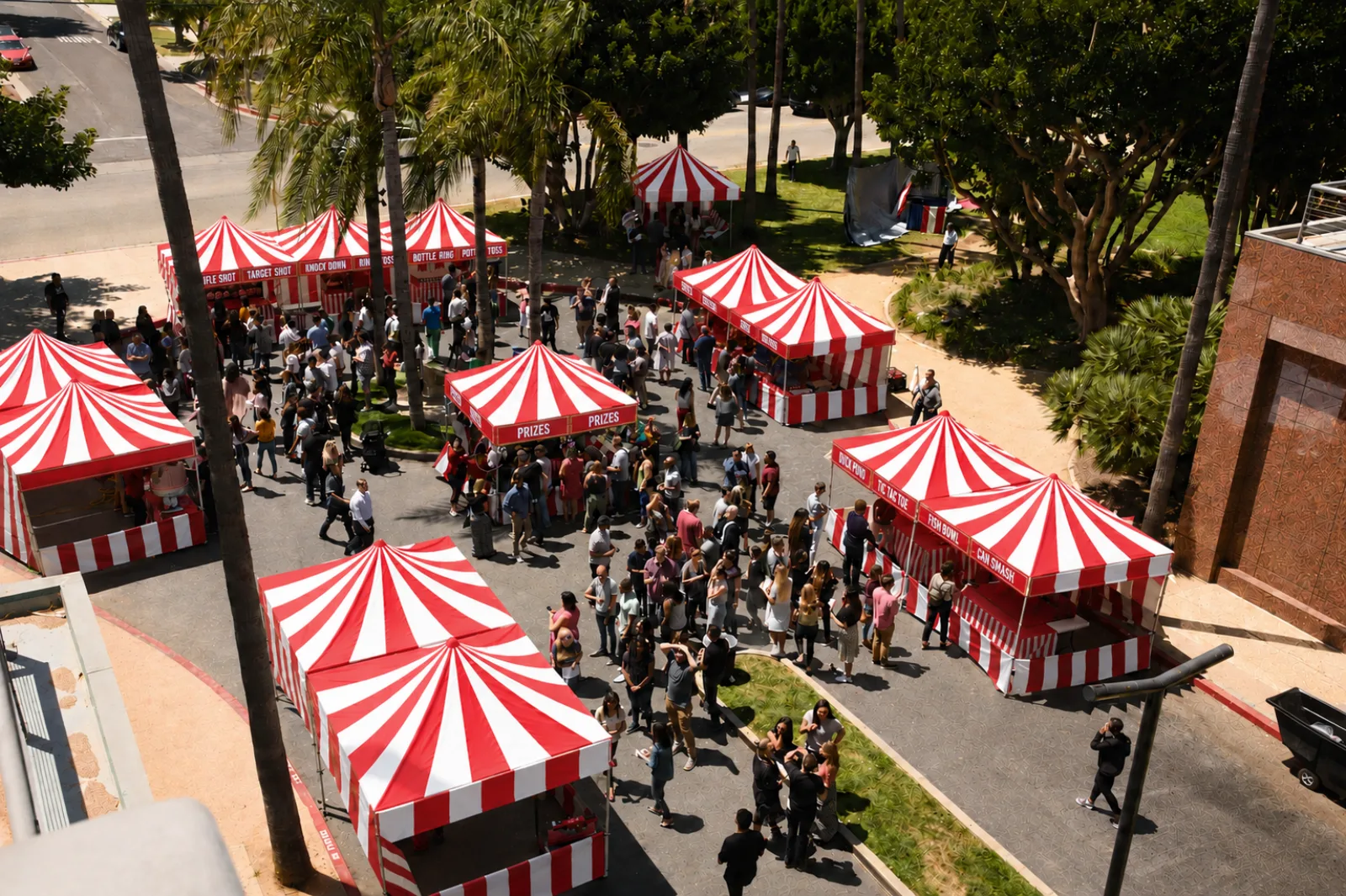
A mid-scale public event at Carmel Valley Community Park, a departmental family day drawing somewhere between 400 and 1,200 guests, typically claims a defined section of the open turf near the parking and field access. The carnival layout runs as a row or a loose grid: six to twelve striped booths, a concession cluster near the main walk-in point, and a prize table set apart from the games so lines don't cross. City staff manage the surrounding program, whatever mix of stage announcements, department information tables, and vendor rows the event carries, while the carnival crew runs its footprint as a contained operation that doesn't need supervision from the city side once it's built.
The jump from a resident-scale event to a citywide one is mostly a staffing and load-time question. A larger public festival needs several hours of pre-event build, a crew large enough to cover every booth and station at once, and a strike plan timed against the city's own teardown so neither team is working around the other. My Little Carnival assigns one production lead as the single point of contact with the city's event coordinator for the day, so any mid-event call, a booth relocation, an extra concession run, gets made once rather than negotiated booth by booth.
What's typically included.
-
Striped game booths at scale.
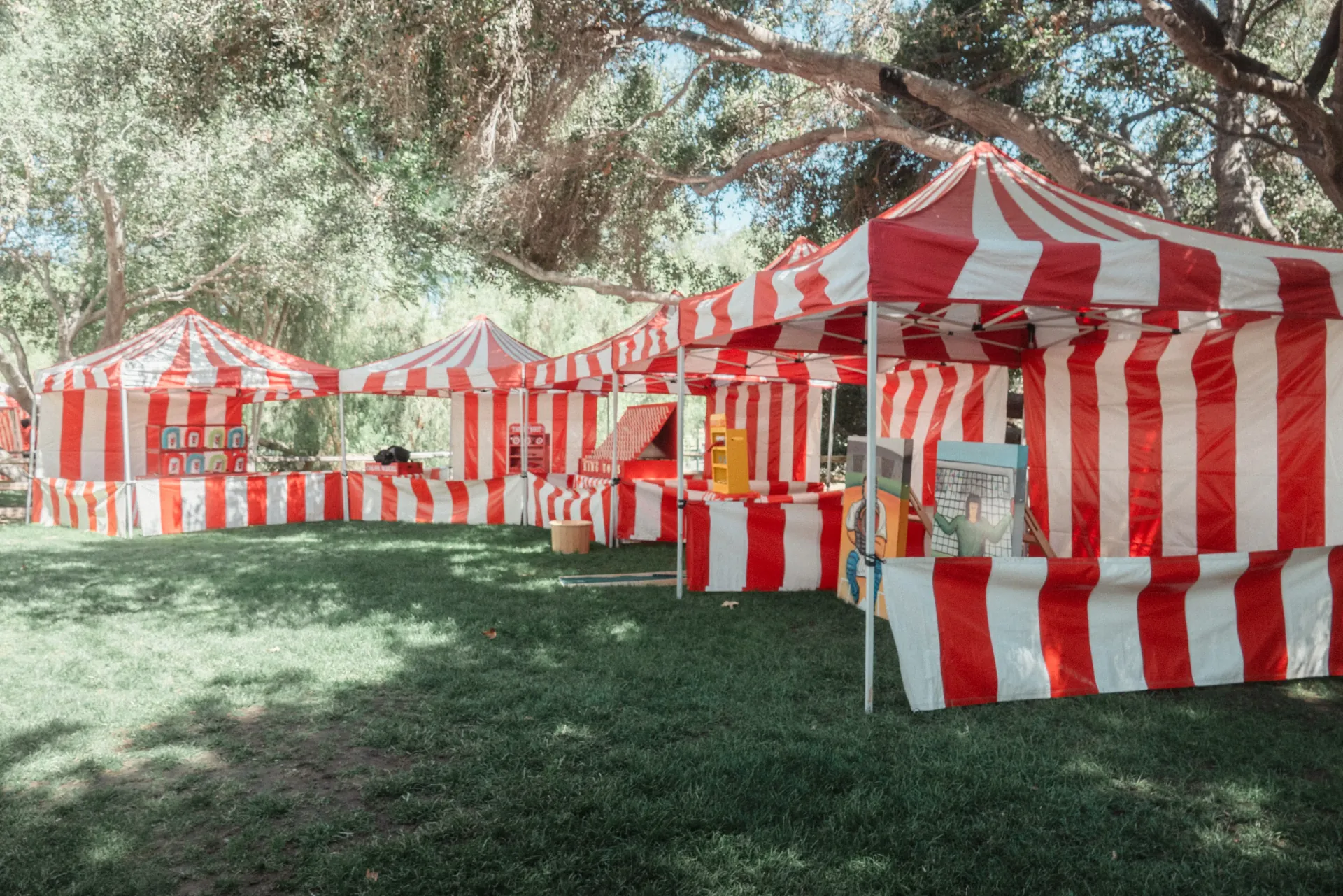
Six to twenty high-peak striped tents depending on expected turnout, arranged as a row, loose grid, or perimeter to fit the park's open turf or paved plaza. Booths arrive pre-skirted with signage and prize displays already built out.
-
Carnival games + prize inventory.
Standard midway games, ring toss, bottle knockdown, plinko, a fishing pond, sized to a mixed-age public crowd. Prize inventory covers both consolation and top-tier tiers and gets restocked through the event window rather than running dry mid-afternoon.
-
Concession stations.
Popcorn poppers, cotton candy spinners, and snow cone machines in a quantity matched to the projected headcount. All consumables and packaging are included for the booked window; no city staff time goes toward running them.
-
Trained attendants.
One staff member per booth and concession station across the full event window, plus a production lead on-site who stays in direct contact with the city's event coordinator for anything that comes up mid-day.
-
Setup, strike, and logistics.
Crew arrives ahead of the event to build the full layout and begins strike as soon as the window closes. All transport, load-in, and load-out is handled by the production team, and the field or plaza is left as found.
-
Certificate of Insurance.
My Little Carnival provides a COI naming the City of San Diego and any required co-insureds, matched to whatever the department's facility-use or vendor-authorization process specifies before the event date.
Typical timeline for city + municipal events in Carmel Valley.
- 1
12-16 weeks out
Parks-and-rec staff or a public-event coordinator typically opens vendor outreach at this point. Scope gets discussed: booth count, concession lineup, footprint size, and whether a bid process or vendor-registration step applies. Starting this early gives room for those steps without squeezing the production timeline.
- 2
6-8 weeks out
Scope locks, contract signs, and deposit clears. The COI goes out naming the City of San Diego and any required co-insureds. The park-use permit and vendor-authorization paperwork should be moving on the city's end by this point.
- 3
Week of
Final headcount confirmed, layout walked through with the production lead against the actual venue, and power access verified. A generator plan is confirmed if the park's outdoor circuits won't cover the full concession and booth load.
- 4
Event day
Crew arrives several hours ahead of the event opening, sets every booth, pre-heats concessions, and briefs attendants before the first guest arrives. The production lead stays reachable by the city coordinator all day. Strike starts as soon as the window closes.
Specifics for Carmel Valley.
- Venue load-in at Carmel Valley Community Park: The park's open turf and multiple field access points support vehicle load-in for larger productions, which matters at the higher end of the booth count since a bigger build needs multiple truck runs across the site rather than a single drop point.
- Power at San Diego parks: Concession machines and any inflatable blower combined draw meaningful amperage, and most city park sites don't carry dedicated outdoor circuits rated for a full carnival load. My Little Carnival brings a generator array for anything past a minimal booth count, and this should be flagged during the site walk-through so it's already on the plan the city reviews.
- City of San Diego vendor authorization: Public events at Carmel Valley Community Park or through the Carmel Valley Recreation Center run through a City of San Diego park-use permit process, which can include vendor registration, a W-9, and department sign-off before a contract executes. Opening vendor outreach twelve to sixteen weeks ahead builds in buffer for that process. School-affiliated public events through Del Mar Union School District or San Dieguito Union High School District tend to follow a similar authorization timeline.
- Coastal marine layer: Carmel Valley sits close enough to the coast, and to Torrey Pines State Natural Reserve, that a marine layer is routine most mornings and typically burns off by late morning. Public events scheduled for an afternoon start tend to land in the most reliable weather window, and a rain contingency is worth naming for any date scheduled outside the dry months.
- Ticketing and wristband coordination: Larger public festivals sometimes issue city wristbands or tokens for carnival access, either bundled with general admission or sold at a central table. My Little Carnival works within whatever ticketing structure the city or event coordinator has already set up for the day.
- Multi-vendor coordination: Citywide festivals in this part of San Diego often layer food trucks, community-group booths, and stage programming alongside the carnival footprint. The production lead coordinates load-in order and footprint boundaries with the city's coordinator so setup and strike don't collide with the rest of the event, which matters most at venues with a single main access point.
Common questions.
How far in advance do Carmel Valley public events typically need to book?
Twelve to sixteen weeks is the realistic minimum once a City of San Diego park-use permit or vendor-registration process is involved. Smaller department events with a shorter authorization path can sometimes move faster, but earlier outreach is always the safer play for locking the date and getting COI paperwork in ahead of any facility-use deadline.
What does a COI for a Carmel Valley municipal event typically need to include?
Generally a general liability minimum around $1M per occurrence and $2M aggregate for a public event at this scale, with the City of San Diego named as additional insured and sometimes a co-sponsoring department listed as well. My Little Carnival issues the COI once the contract is signed; the exact additional-insured wording comes from the city's own vendor-authorization documents.
How many booths does an event with around 800 guests need?
A workable rule of thumb is one booth per seventy-five to one hundred guests for reasonable wait times. An 800-guest event spread across four to six hours runs comfortably on eight to ten booths plus a concession row. A compressed one-hour surge instead of a spread-out afternoon pushes that number up.
Can the carnival footprint work inside a larger citywide festival?
Yes, this is the most common format at Carmel Valley Community Park. The carnival occupies a defined section within the larger festival layout while food trucks, community booths, and stage programming take up adjacent ground. The production lead coordinates load-in order and boundaries with whoever runs the broader event.
What happens if a public event needs to move for weather?
Rescheduling terms sit in the contract and depend on how much notice the change gets. Public events with a rain-contingency date already written into the venue authorization are in the strongest position, since rebooking a City of San Diego park for a new date can take close to as long as the original permit process.
Do smaller parks-and-rec events, not full festivals, fit this service?
Yes. A smaller-scope booking, a parks-and-rec family afternoon at the Carmel Valley Recreation Center with 200 to 300 guests, a holiday tree-lighting with a carnival add-on, or a department community day, sits toward the lower end of this pricing tier. The COI process, vendor authorization, and production approach stay the same; booth count and staffing just scale down.
About this guide.
This local guide to City + Municipal Events in Carmel Valley was compiled by My Little Carnival, a division of My Little Carnival, producers of public festivals, school carnivals, and community events across San Diego County.
Helpful local references: City of San Diego Parks & Recreation · Del Mar Union School District
City + Municipal Events in nearby cities.
Planning a city or municipal event in Carmel Valley?
Share the event date, expected guest count, venue, and any permit or vendor-authorization requirements, and My Little Carnival will scope a production sized to the park footprint and the city's process.
Get a quote →