city + municipal events in San Diego.
A city or municipal carnival event is a publicly organized celebration run through a city department rather than a private host: a parks-and-recreation summer series, a citywide festival, a holiday tree-lighting with a carnival add-on, or a Fourth of July community day. A carnival production supplies the midway infrastructure, striped game booths, concession stations, and prizes, while city staff run the surrounding program: stage entertainment, vendor rows, traffic control, and permitting. At the municipal scale the footprint runs considerably wider than a school or backyard event. Guest counts range from a few hundred at a neighborhood parks-and-rec afternoon to several thousand at a citywide festival, and turnout for a public event is rarely a fixed number the way an invite-only booking is. This is a local guide to City + Municipal Events in San Diego: how these bookings are typically structured, which venues and departments host them, and what a production at this scale actually includes.
San Diego's municipal event calendar runs through several city departments and a wide venue list. Balboa Park and the Balboa Park Activity Center host citywide festivals and cultural celebrations that draw walk-up crowds well beyond a single neighborhood. Mission Bay Park's open shoreline lawns suit parks-and-rec programming that wants water views and generous parking. Mission Trails Regional Park anchors community days along the Mission Gorge corridor, and the plazas around Snapdragon Stadium occasionally host larger citywide gatherings tied to a stadium event. My Little Carnival has produced carnival events for the City of San Diego directly, alongside similar municipal work for the City of Long Beach, City of Redlands, City of Monrovia, City of Coachella, and City of San Marcos, so the vendor paperwork and city-authorization process are familiar territory rather than a first-time learning curve. Families across most of these venues fall within San Diego Unified School District boundaries, which is often the audience a parks department is trying to reach with holiday and summer programming in the first place.
My Little Carnival produces city-scale carnival events across San Diego County, with public-event production experience gained working directly with city parks and recreation departments on citywide festivals and holiday programming.
How a city or municipal event unfolds in San Diego.
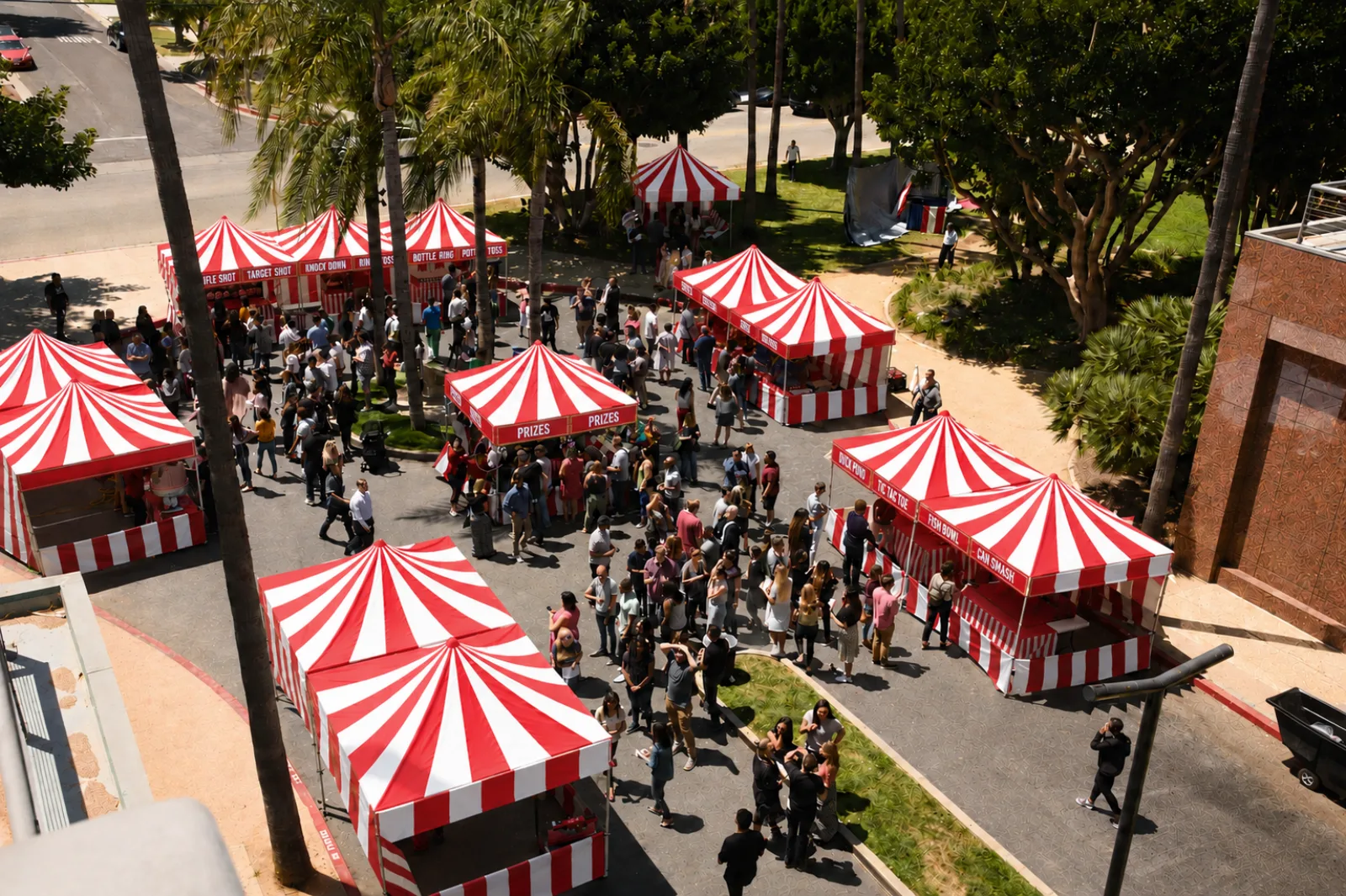
A citywide festival at a venue like Balboa Park or Mission Bay Park typically claims a defined section of open lawn or paved plaza rather than the whole grounds. The carnival footprint sits inside a horseshoe or grid, ten or more striped booths along the perimeter, a concession row positioned near the main pedestrian entry, and a prize table near the exit so families leave through a single controlled point. City parks staff and the department's event coordinator run everything outside that footprint, stage programming, vendor rows, traffic and parking control, while the carnival crew operates its section as a self-contained unit that plugs into the larger event.
Staffing and concession counts get built with a buffer that private bookings don't need, since a public event doesn't have an RSVP list. A parks-and-rec afternoon expecting 300 guests can pull double that if the weather cooperates and word spreads through the neighborhood, so booth count and popcorn, cotton candy, and snow cone supply are planned against a range rather than a fixed head count. My Little Carnival assigns a production lead who stays in direct contact with the department's event coordinator for the full window, so any mid-event adjustment, an unexpected crowd surge, a layout change, a power issue, routes through one point of contact instead of getting sorted booth by booth.
What's typically included.
-
City-vendor + COI paperwork ready.
A Certificate of Insurance naming the city department, and any required co-sponsoring agency, as additional insured, prepared to match whatever vendor-authorization process the department's facility-use or purchasing office requires before the event date.
-
Scaled setup for public-event footprints.
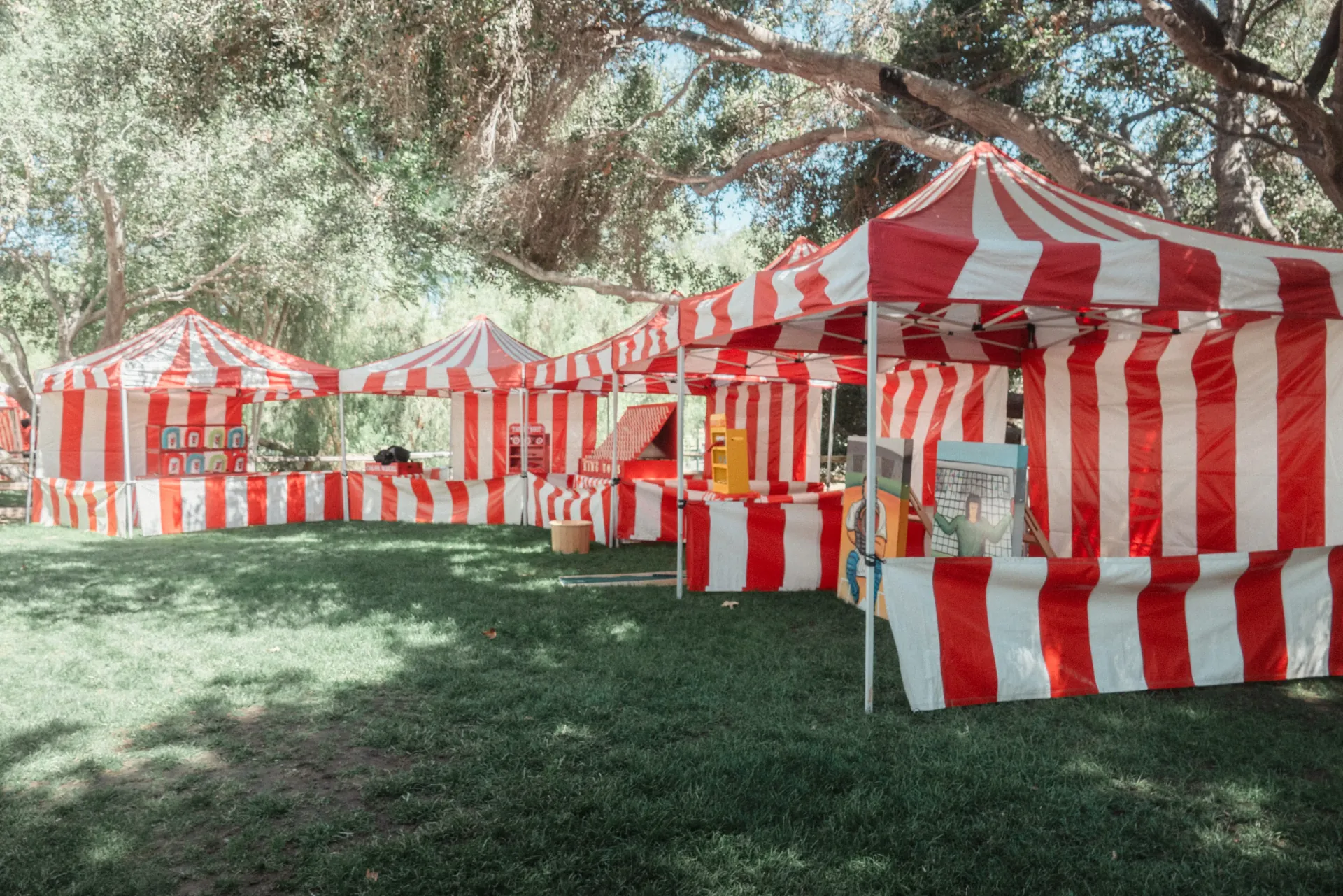
Booth counts and layout built for a range from a parks-and-rec afternoon of a few hundred guests up to a citywide festival north of 2,000, configured to whatever lawn, plaza, or blacktop the venue provides.
-
Concessions sized for unpredictable attendance.
Popcorn, cotton candy, and snow cone supply planned against a guest-count range rather than a fixed RSVP total, since a public event's turnout depends on weather and word of mouth more than a private booking's guest list does.
-
Coordination with city facilities and parks staff.
A production lead stays in direct contact with the department's event coordinator throughout setup and the event window, routing load-in sequencing, footprint boundaries, and any mid-event adjustment through one point of contact.
-
Carnival games and prize inventory.
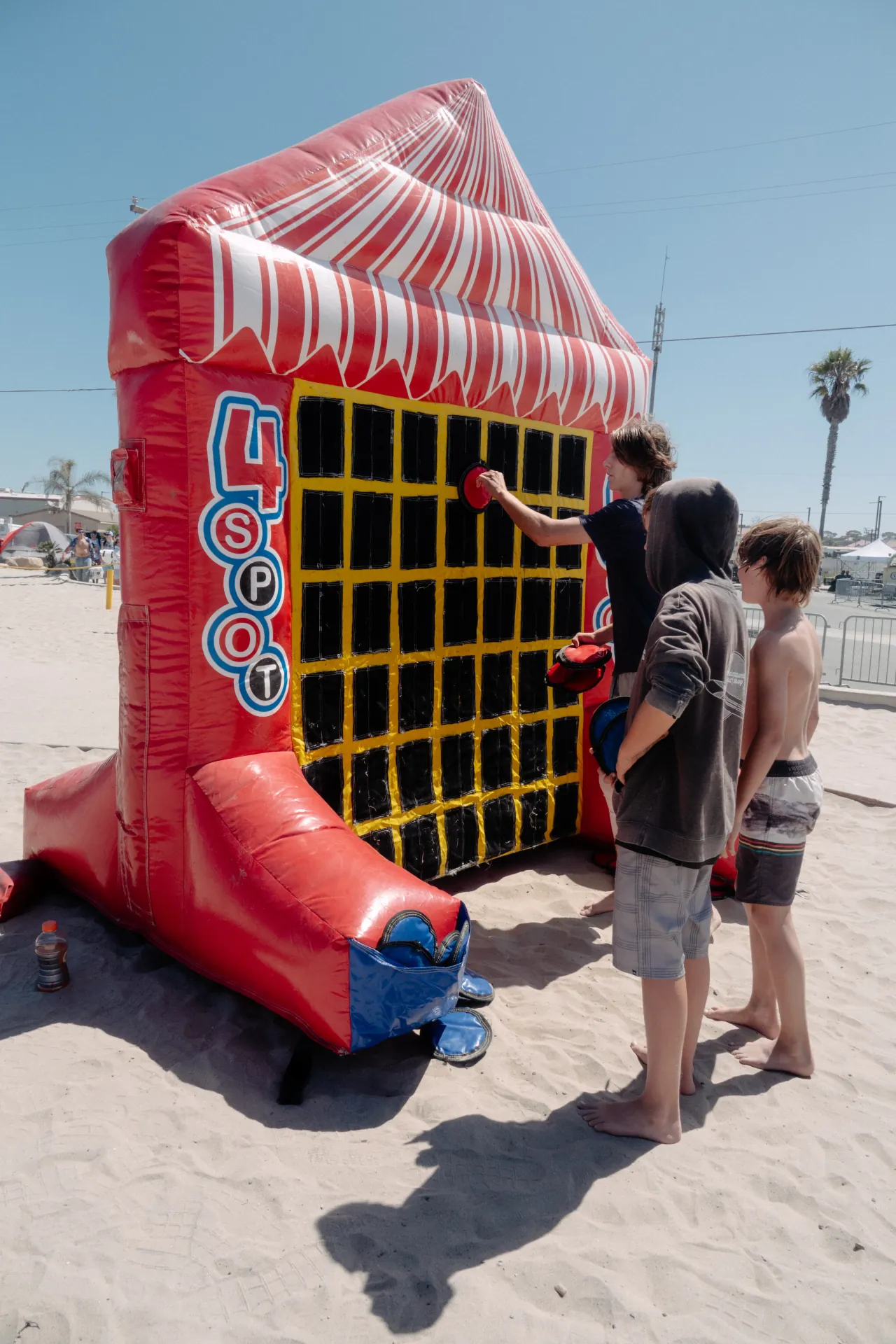
Ring toss, bottle knockdown, plinko, and similar midway games, restocked with consolation and top-tier prizes through the full event window regardless of how attendance runs against the initial estimate.
-
Setup, strike, and logistics.
Crew handles transport, load-in, and load-out on both ends of the event, and coordinates strike timing with the department's own teardown schedule so the two don't compete for the same access points.
Typical timeline for city + municipal events in San Diego.
- 1
3-6 months out
Public-event lead times run long because of council approvals, department budget cycles, and facility-use review. City departments and event coordinators typically start vendor outreach at this stage; scope gets discussed, a quote gets prepared, and any required bid or vendor-registration process has room to run without compressing the production timeline.
- 2
6-8 weeks out
Scope is locked, contract signed, deposit paid. The Certificate of Insurance goes out naming the department and any co-sponsoring agency, and the facility-use or vendor-authorization paperwork should be moving on the city's end by this point.
- 3
Week of
Final guest-count range confirmed, layout walk-through with the production lead, power access verified against the venue's outlets, and a rain contingency reviewed for a winter or early-spring date.
- 4
Event day
Crew arrives several hours ahead of the opening time, booths and concessions are staged and stocked before the first guest arrives, and the production lead stays reachable to the department's coordinator through strike, which begins as soon as the event window closes.
Specifics for San Diego.
- Council approvals and lead time: City departments across San Diego often route event budgets and vendor contracts through council or department-head approval before a date is confirmed, which is why public-event lead times run three to six months rather than the six to eight weeks a private booking needs. Starting outreach early leaves room for that process without forcing a compressed production timeline.
- Venue load-in: Balboa Park, Mission Bay Park, and Mission Trails Regional Park all have vehicle access to their main event areas, which matters at citywide scale, a fifteen-plus booth production needs multiple truck runs. Sites without a direct load-in route to the event footprint may require hand-trucking equipment across distance, worth flagging during the site walk.
- Power at city venues: Concession machines pull a dedicated circuit that most park and plaza outlets aren't rated to cover at festival scale. My Little Carnival typically brings a generator array for events beyond a minimal booth count, and that plan should be part of the site layout submitted to the department ahead of time.
- Multi-department, multi-vendor coordination: A citywide festival often layers the carnival footprint alongside food trucks, craft vendors, and a stage program managed by a different department or a contracted event coordinator. The production lead works out load-in sequencing and footprint boundaries with whoever owns the broader event logistics so setup and strike don't collide.
- Climate across the city: San Diego's coastal neighborhoods run a morning marine layer that typically clears by midday, while venues further inland see warmer afternoon temperatures with less cloud cover. Outdoor dates are low-risk year-round by regional standards, but a shade and hydration plan is worth building around whichever side of that split the venue falls on.
San Diego, CA.
ZIPs: 92101 · 92102 · 92103 · 92104 · 92105 · 92106 · 92107 · 92108 · 92109 · 92110 · 92111 · 92112 · 92113 · 92114 · 92115 · 92116 · 92117 · 92119 · 92120 · 92121 · 92122 · 92123 · 92124 · 92126 · 92127 · 92128 · 92129 · 92130 · 92131 · 92132 · 92134 · 92135 · 92136 · 92137 · 92138 · 92139 · 92140 · 92142 · 92145 · 92147 · 92149 · 92150 · 92152 · 92153 · 92154 · 92155 · 92158 · 92159 · 92160 · 92161 · 92163 · 92165 · 92166 · 92167 · 92168 · 92169 · 92170 · 92171 · 92172 · 92174 · 92175 · 92176 · 92177 · 92179 · 92182 · 92186 · 92187 · 92190 · 92191 · 92192 · 92193 · 92195 · 92196 · 92197 · 92198 · 92199
My Little Carnival delivers city + municipal events throughout San Diego and the surrounding San Diego County area. Pin shows the city center; we cover every ZIP listed above.
Common questions.
How far ahead do San Diego city events typically need to book?
Three to six months is the practical range once council approval, department budget cycles, or a formal bid process are involved. Smaller parks-and-rec bookings with a simpler authorization path can sometimes move faster, but earlier outreach protects the date and gives the Certificate of Insurance time to clear the department's facility-use process.
What does the Certificate of Insurance need to name?
Generally the city department hosting the event, and sometimes a co-sponsoring agency or district, as additional insured, with coverage limits set by whatever facility-use or vendor-authorization document the department issues. My Little Carnival prepares the COI once the contract and scope are set.
How does staffing and concession supply handle a public event's unpredictable attendance?
Booth count and concession supply get planned against a guest-count range instead of a fixed RSVP total. A parks-and-rec afternoon quoted for 300 to 500 guests plans concessions toward the higher end of that range, since a public event with no guest list can draw more than expected if the weather holds and word travels through the neighborhood.
Does this service cover a smaller parks-and-rec event, not just a citywide festival?
Yes. A single-park family afternoon with a couple hundred guests sits at the lower end of this service's scope, alongside citywide festivals and holiday celebrations with a carnival add-on at the upper end. The COI, department coordination, and production process stay the same; booth count and staffing scale down to match.
Can the carnival work alongside other city departments and vendors at the same event?
Yes, this is the more common format at citywide scale. The carnival occupies a defined section within the larger festival footprint while food trucks, craft vendors, and a stage program run in adjacent areas, often under a different department or a contracted event coordinator. The production lead coordinates footprint boundaries and load-in timing with whoever manages that broader layout.
What does a holiday celebration with a carnival add-on typically include?
A tree-lighting or Fourth of July program usually runs the carnival as one component alongside the city's core programming, stage entertainment, a lighting ceremony, fireworks, rather than as the standalone event. Booth count runs smaller than a full festival, and the production window is built around the timing of the department's main program.
About this guide.
This local guide to City + Municipal Events in San Diego was compiled by My Little Carnival, a carnival event production operation serving San Diego County, a division of My Little Carnival.
Helpful local references: City of San Diego Parks and Recreation · City of San Diego
City + Municipal Events in nearby cities.
Planning a city or municipal event in San Diego?
Share the event date, expected guest-count range, venue, and any council or procurement requirements, and My Little Carnival will scope a production that fits the footprint and works within the department's vendor-authorization process.
Get a quote →